Are you getting the right people on the AI-transformation bus? And have they bought their tickets for the destination?

A recent roundtable that I attended revealed what senior B2B marketers are really saying about AI – and what that’s likely to mean for your team.
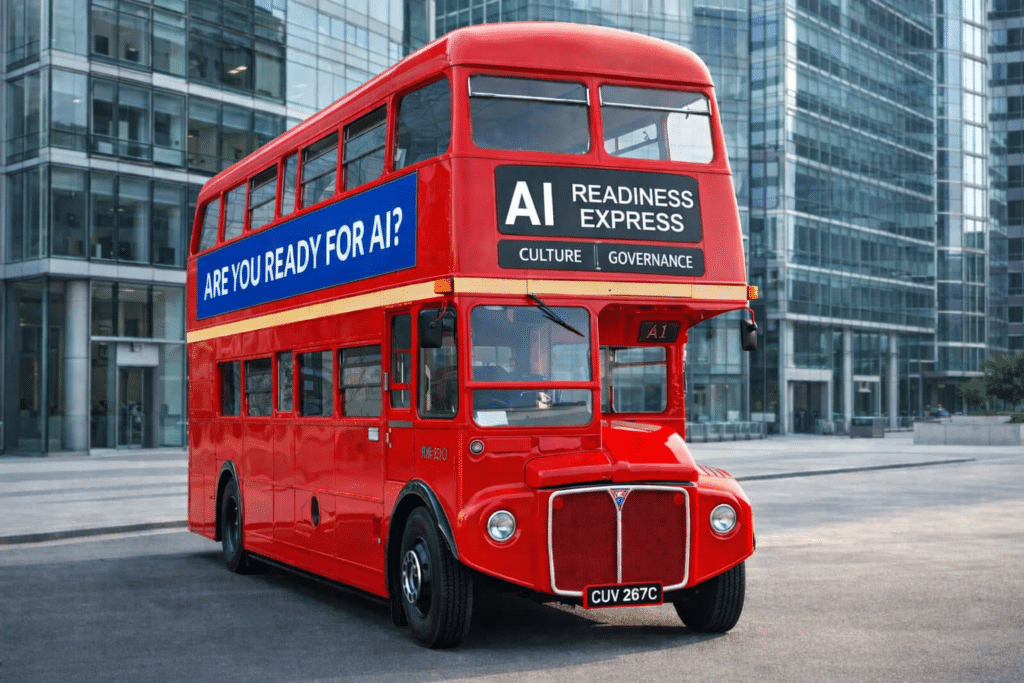
At a certain point in almost every conversation about AI that took place at a recent senior B2B marketing roundtable sponsored by HelloKindred, someone reached for the same metaphor. The bus. Whether it was the CEO who literally hired a red London bus to launch their company’s AI programme to nine thousand employees, the marketing leader talking about which team members were genuinely on board versus clinging to the door frame, or the CMO quietly wondering whether their organisation had even found the bus stop yet — the image kept returning. And it kept returning because it captures something true. As you’ll see in this post, it certainly got my creative juices flowing!
This is not a slow, optional, theoretical journey. The bus is running. It has been running for a while. The organisations that are pulling ahead are not necessarily the ones with the most sophisticated tools or the biggest AI budgets. They are the ones that have worked out where they are going, got the right people on board, and started moving with genuine intent.
The roundtable brought together CMOs and senior marketing leaders from some of the UK’s most recognisable organisations for a conversation that was, by turns, honest, energising and uncomfortable. What emerged was not a single playbook but a vivid, varied picture of where B2B marketing teams actually are with AI right now — as opposed to where the conference circuit and the vendor decks suggest they should be.
The central question that ran through everything was deceptively simple. Are you getting the right people on the bus? And just as importantly — do you know which stop you are currently at?
Everyone is at a different stop. That’s the reality
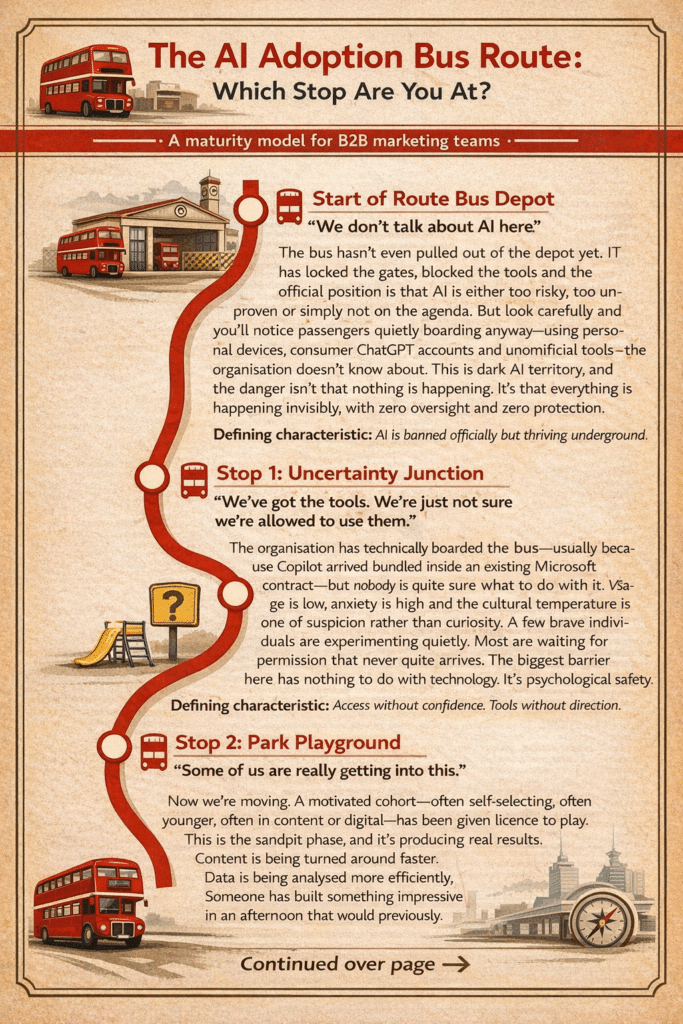
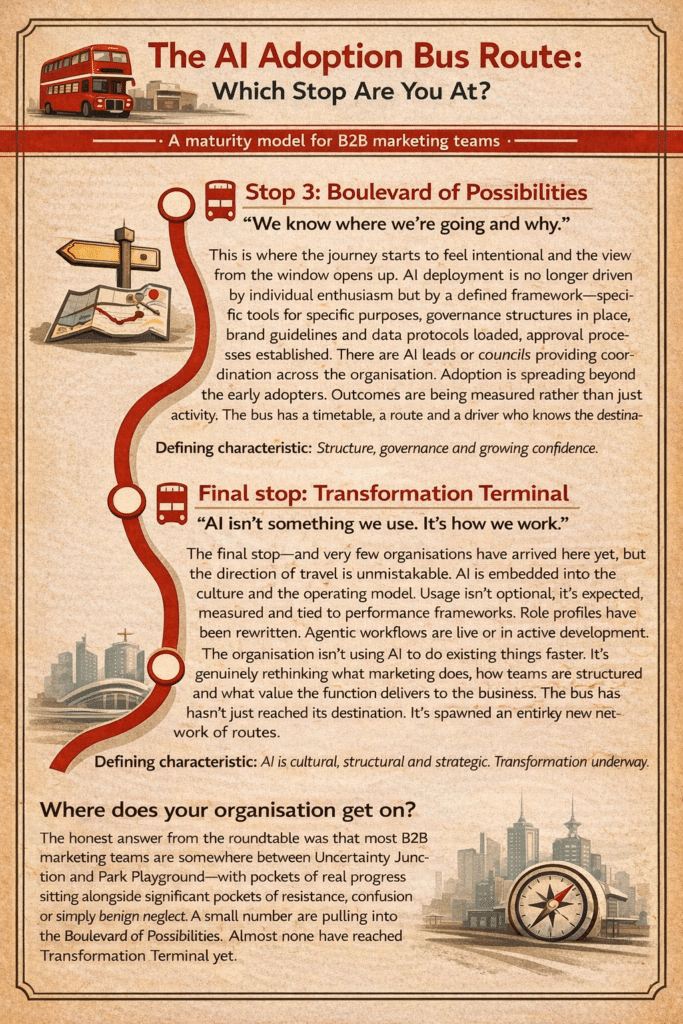
Perhaps the single most important thing to understand about AI readiness in B2B marketing right now is that there is no single picture. The range of maturity visible in just one room of senior practitioners was striking. At one end, organisations where IT has effectively locked down all AI tools, where staff are quietly using personal devices and consumer platforms the business knows nothing about — what the room referred to as dark AI — and where the official position ranges from cautious to outright prohibitive. At the other, organisations where AI usage is not just permitted but mandated, measured against OKRs and tied directly to performance frameworks, with enterprise subscriptions, dedicated AI leads and agentic workflows already in active development.
The temptation is to frame this as a story about the bold and the timid. It is not. The organisations moving more slowly are frequently doing so for entirely legitimate reasons — regulated industries, complex legacy IT environments, global data compliance requirements, cautious legal teams working through genuinely unresolved questions. Maturity is not simply a function of ambition. It is a function of context. And understanding your own context clearly — your ownership structure, your customer base, your geographic footprint, your risk appetite — is not a precursor to building your AI strategy. It is the foundation of it.
What was equally clear, however, is that standing still is not a neutral position. The dark AI phenomenon is real, it is widespread, and it means that the choice for many organisations is not between moving and not moving. It is between moving with a plan and moving without one.
The competency gap nobody wants to admit
Here is the insight from the morning that deserves the most airtime, because it reframes the entire conversation. The challenge most B2B marketing teams are facing right now is not an AI adoption problem. It is an AI competency problem. And there is a profound difference between the two.
Access to tools is no longer the bottleneck for most organisations. Copilot is bundled into Microsoft contracts. Claude and ChatGPT are a browser tab away. The sandpit is open and the playground is well-equipped. What is missing — and what is genuinely hard to build quickly — is the capability to use these tools well. To prompt effectively. To evaluate outputs critically. To know the difference between something that is merely functional and something that is genuinely good.
This is where the bus metaphor becomes most useful. The right people on the bus are not necessarily the most digitally native or the most enthusiastic early adopters. They are the ones with the judgement to know when the output in front of them is heading in the wrong direction. AI is remarkably good at producing 80% of average. Competent, functional, indistinguishable from the middle of the market. The human skill of knowing what the remaining 20% looks like — and how to get there — is not becoming less important as AI advances. It is becoming the most important differentiator in the room.
There is an uncomfortable paradox sitting at the heart of this. The junior team members who are frequently most enthusiastic about AI, and most fluent in its day-to-day operation, are often the least equipped to evaluate its outputs with the critical eye that experience provides. Meanwhile the more senior marketers who have spent careers developing exactly that evaluative judgement are frequently the most resistant to engaging with the tools at all. Bridging that gap — creating genuine two-way mentorship between digital fluency and hard-won marketing craft — is one of the most valuable investments a marketing leader can make right now.
Governance: the guardrails that set you free
The instinctive response to governance in most marketing conversations is a slight glazing of the eyes. It sounds like the thing that slows you down, the department that says no, the process that sits between you and the thing you are trying to do. The marketers in the room who were making the fastest and most sustainable progress told a different story entirely. They had brought their governance teams in early, treated them as allies, and found that the result was not slower progress but more confident progress.
Good governance — around data compliance, brand consistency, output quality and data provenance — does not slow your AI deployment down. It gives you the licence to move at pace without exposing the business to the risks that tend to bring everything to a sudden, expensive halt. Think of it less as a barrier at the side of the road and more as the thing that makes it safe to put your foot down.
Practically, this means knowing your organisational context before you build your framework. It means loading your brand guidelines, your messaging architecture and your tone of voice into your AI systems so that what comes out reflects who you are. It means establishing clear standards around what data can be used, how outputs are reviewed and what approval processes apply to different categories of content. And perhaps most importantly, it means creating the psychological safety that allows people to experiment purposefully within defined boundaries — rather than either freelancing dangerously or disengaging entirely.
Stop chasing tools. Start solving problems.
If there was a single piece of practical wisdom that surfaced more consistently than any other across the morning, it was this: the organisations that are making real, sustainable progress with AI are not the ones with the most tools. They are the ones with the clearest problem statements.
Tool-first thinking feels productive. There is always something new to evaluate, something impressive to demo, something a competitor appears to be using. But organisations that have built their AI strategy around platforms rather than problems are finding themselves in a constant cycle of implementation and rebuild as the technology evolves beneath them. The tools will keep changing. The business challenges you need to solve are considerably more stable.
The shift that characterises the organisations pulling ahead is a deceptively simple one. Before reaching for a platform, they ask: what is the specific challenge in our marketing function that we are trying to address? What does success look like? How will we know if we have achieved it? From that foundation – a clear business requirement, a defined outcome, a measurable result – the questions of which tools, which partners and which skills are needed become considerably more tractable. The bus has a destination. Now you can plan the route.
The junior talent question the industry is avoiding
Of all the topics covered across the morning, this was the one that generated the most genuine, unguarded concern. And it deserves to be named directly rather than buried in the footnotes of the AI conversation.
As AI takes on more of the work previously handled by junior marketers — drafting, research, basic analysis, content production, campaign reporting — entry-level roles are beginning to contract. In the short term, for an organisation under budget pressure, that can look like an efficiency gain. In the medium term, it is a serious problem that the industry is not yet reckoning with honestly enough.
Those junior roles are not just about getting work done. They are where the next generation of senior marketing judgement is formed. They are where people learn to distinguish good from average, develop commercial instinct, build the craft knowledge that eventually allows them to look at an AI output and know, with confidence, whether it is right. Strip out those roles and you are not just saving headcount costs today. You are quietly hollowing out the capability pipeline that your marketing function will depend on in five to ten years.
The organisations thinking most carefully about this are the ones actively preserving meaningful learning and development opportunities even as AI automates more of the underlying work. Not because it is comfortable or cheap, but because they understand what is actually at stake.
The human in the machine
The most powerful thread running through the entire morning was also the most straightforward. AI is most effective not when it replaces human judgement but when it is genuinely empowered by it. The best results being generated right now — the most impressive workflows, the sharpest outputs, the most commercially significant applications — share a common characteristic. A skilled, experienced human working in real partnership with AI tools. Prompting with precision. Evaluating with rigour. Applying strategic and commercial context that the machine cannot generate alone.
This is what getting the right people on the bus actually means. Not the most digitally enthusiastic. Not the most technically proficient. The ones with the curiosity to keep exploring, the commercial acumen to connect AI capability to business outcomes, and the confidence to treat these tools as powerful collaborators rather than either an existential threat or an infallible oracle.
The bus is running. It has been running for a while. The question is not whether to get on. It is whether you are navigating — or just along for the ride.
Practical takeaways
For marketing leaders looking to move purposefully from wherever they currently are, the conversation distilled into a handful of principles worth taking back into the business:
- Know your stop before you plan your route. Honest self-assessment of where your organisation actually sits on the AI maturity journey — not where you would like to be — is the essential first step. The accompanying maturity model is a practical starting point for that conversation with your leadership team.
- Reframe governance as your accelerator. Bring your legal, compliance and IT stakeholders in early. Define your guardrails before you scale your experimentation. The organisations moving fastest are not the ones that bypassed governance. They are the ones that built it properly from the start.
- Invest in competency, not just access. Audit honestly what AI skills actually exist in your team beyond basic tool usage. Build two-way mentorship between digital fluency and marketing craft. The ability to evaluate AI outputs critically is the most valuable skill you can develop right now.
- Anchor everything to a business problem. Before evaluating any new tool or platform, define the specific challenge you are trying to solve and what success looks like. Let your requirements drive your tool selection, not the other way around.
- Protect your junior talent pipeline. Even as AI automates more of the underlying work, preserve meaningful opportunities for junior marketers to develop the foundational craft and judgement that your function will depend on in the years ahead.
- Build for the human-AI partnership. Design your workflows, your team structures and your performance frameworks around the assumption that the best results come from skilled humans and powerful AI tools working in genuine collaboration — with human oversight and critical judgement at the heart of everything.
Let's connect
Whether you’re looking for a speaker, collaborator, or advisor, I’d love to help you bring fresh perspective to your B2B audience.
Follow me on:


