Turned down to zero: the employee advocacy signal B2B brands keep ignoring

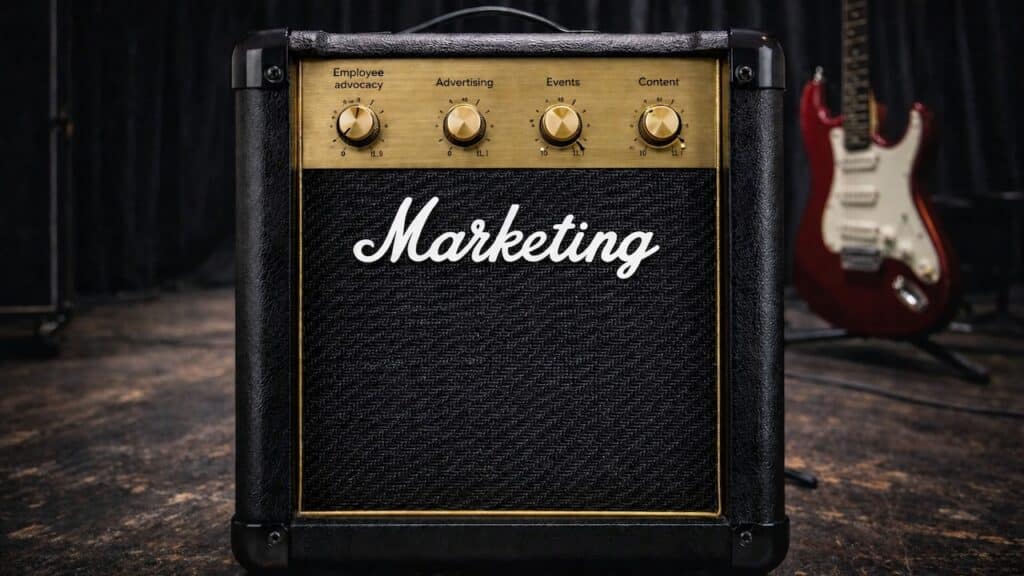
Analysis of entries to the B2B Marketing Awards shows that every other channel is turned up loud. But employee advocacy — the most trusted signal in B2B marketing — is barely registering. Robyn Hartley of Paper Kite Media helped me dig into the data.
In an era of fragmenting media, shrinking organic reach and deepening audience scepticism towards brand content, the case for employee advocacy has never been more compelling. Employees bring something that paid channels simply cannot replicate: genuine expertise, real relationships and authentic voices that audiences are increasingly choosing to trust over corporate messaging. Most B2B marketers know this. The question — as a rigorous analysis of hundreds of B2B Marketing Awards 2025 entries reveals — is why so few campaigns are actually acting on it.
That’s the question at the heart of this analysis, and to help make sense of what the data reveals, I was joined on the Trust & Influence in B2B podcast by Robyn Hartley, Managing Director of Paper Kite Media, one of the sharpest practitioners working in this space.
The findings are both encouraging and genuinely challenging. But before we get into them, it’s worth being precise about what we mean by employee advocacy — and equally precise about what we don’t.
Two types of employee advocates
Employee advocacy describes the structured activation of employees, at any level, as communicators on behalf of their organisation. It is distinct from the broader tradition of B2B thought leadership, which typically centres on senior executive voices — the C-suite figureheads and named partners whose authority flows from who they are: their seniority, their institutional standing, the decisions they make. Employee advocacy draws on a different kind of authority entirely.
Within it, two meaningful personas emerge. The first are employee amplifiers: employees deployed collectively to extend reach by sharing or reposting content, where the individual’s identity is largely secondary to the volume of distribution they provide. The second are employee thought leaders: named individuals whose influence derives not from their position in the hierarchy but from what they know — their subject matter expertise, peer credibility and the trust they’ve built with a specific audience over time. A product specialist, a solutions engineer, a sector expert: people whose voice carries weight because of the depth of their knowledge, not the height of their title.
Keeping that taxonomy clear matters — because conflating employee thought leaders with the senior executive tradition, or treating amplifiers and thought leaders as interchangeable, is one of the reasons the discipline is so frequently misunderstood and undermeasured.
It’s also why the numbers land with such force. Just under 14% of campaign entries included employee advocacy as an explicit mechanic — roughly one in seven. Of those, only 2.9% deployed genuine employee thought leadership. The remaining 10.9% were amplifier-led: employees sharing and reposting content as a distribution layer. For a discipline with this much potential, that’s a striking gap between belief and practice.
LinkedIn: structurally dominant, strategically narrow
Almost without exception, every campaign in the analysis ran its employee advocacy activity through LinkedIn. No other platform came close. On the surface this is unsurprising — and Robyn was clear that LinkedIn’s dominance is rational rather than lazy. “It is the only place where you get that professional identity, you’ve got the network structure, some level of intent data, and algorithms — and they all work well together. Other platforms don’t have access to things like job roles, employment history, industry context — the B2B signals we’re looking for when we’re trying to build trust with customers.”
But the risk isn’t LinkedIn itself — it’s the narrowness of thinking that can accompany it. As Robyn put it, “the risk is if you are training teams in a way that only allows them to share on one platform — because you want to create a fundamental cultural change within your team, and that means enabling and empowering them to be able to pivot to other ways.” Platform proficiency and advocacy capability are not the same thing, and the discipline needs to be built around outcomes and audiences, not the mechanics of one channel.
It’s also worth noting that LinkedIn’s dominance hasn’t confined advocacy to brand activity alone. The analysis found employee advocacy appearing across demand generation, ABM and thought leadership categories — a sign that practitioners are beginning to think more strategically about where in the funnel employee voices can do meaningful work.
The episodic trap
If LinkedIn dominance is the discipline’s structural constraint, episodic deployment is its strategic one. Around 70% of amplifier-led campaigns in the analysis were triggered by specific brand moments — a rebrand, a product launch, a significant organisational event. Companies activate their employees, generate a burst of reach, and then the programme effectively stops.
There’s a logic to this, as Robyn acknowledged: “Companies sometimes choose episodic advocacy because it feels easier — you control the message, you control the timing, and it probably feels like you control the risk a lot more. But it doesn’t always mean that it’s effective.” The real cost of episodic advocacy is what it forecloses. “It should be treated as a marathon, not a sprint. Building trust is not an overnight thing — you need to get employees to the point where they feel confident, recognise which topics they should be talking about, and find that rhythm with posting content authentically.”
When that foundation exists, campaign moments land differently. Always-on advocacy means the trust has already been built with the audience before the campaign moment arrives — shortening sales cycles and amplifying impact when it matters most. The most telling exception in the data is LTTS’s brand ambassador programme, explicitly designed as a self-sustaining community that outlasts any single campaign. It’s the minority, but it illustrates what maturity looks like. A brand moment can be a legitimate catalyst for starting a programme — but treating it as the whole programme wastes the groundwork and leaves significant long-term value on the table.The Access Group — Do the Best Work of your Life demonstrated how employee advocacy can function as sales infrastructure, training 400+ sales and BD staff through its own content before anything reached the market. Soldo’s programme embedded employee advocacy into every piece of content it produced
Employees as the first media channel
The strongest campaigns in the analysis share a sequencing principle that sounds obvious but is rarely executed well: activate employees internally before anything goes external. Kelly OCG ran internal events featuring their creative work before any public activation. LTTS refreshed cafés across seven regional campuses before any media spend. Flight NBS used a VR experience to help over a thousand employees connect with a brand refresh — 78% rated their brand connection at eight or above after the experience, compared to 57% before.
Kelly OCG’s framing is the most instructive: they described their employees as “our first media channel.” This reframes the internal launch not as a soft people initiative but as the opening move in the campaign strategy. Robyn is clear on why this sequencing is non-negotiable: “If your team genuinely understand the story and believe in it, they’re excited and more likely to want to play a role. If the opposite occurs — they’re just being asked to share scripted or AI-generated posts — you’ll get low engagement, templated content that won’t earn trust, or just silence.”
And underlying all of this is a principle that the strongest programmes never lose sight of. “A lot of people forget that these aren’t ad units. These are actual people with their own family, friends and peers within their networks, who want to put out content they feel proud of and believe in. It’s really important to treat those experts with the respect they deserve — bring them along the journey so they can choose whether they want to get involved.” Conviction comes before amplification — always.
The measurement gap
Perhaps the most revealing finding in the analysis concerns what happens when these campaigns try to demonstrate their value. Even in campaigns that are otherwise highly commercially rigorous — with clear pipeline attribution, ROI figures and defined business outcomes — the employee advocacy component is almost always reported in reach and volume terms. Number of posts. Number of ambassadors. Organic impressions generated.
Expleo’s campaign generated £44.4 million in pipeline and a 63:1 ROI. Employee advocacy was an explicit component — but its contribution to those numbers was never isolated or quantified. The pattern repeats across the data set.
LTTS offers the most rigorous exception. Their $2,000 programme generated over 10 million organic impressions, and they modelled that reach against equivalent paid LinkedIn CPM costs — which would have run to between $50,000 and $80,000. It’s a compelling efficiency case. But Robyn offers a sharp challenge to this approach: “It kind of treats employees like a cheaper version of display advertising, almost like ad units. Paid media guarantees targeting; organic doesn’t. Pitching advocacy by comparing it to a CPM is purely looking at a volume metric — it doesn’t take into consideration the qualitative impact. Do you have buyers saving down your posts? Are you getting inbound conversations from people within your ICP? Are you getting connection requests from a decision maker you’ve been trying to speak to? Those things should all be considered.”
Closing that gap requires deliberate effort: applying UTMs to shared links, logging when LinkedIn content is referenced in sales conversations, tracking inbound connection requests from target accounts. None of it is glamorous, and much of it is manual. But it’s the difference between advocacy that looks good on a slide and advocacy that demonstrably contributes to revenue.
The untapped commercial opportunity
The final and most significant finding points toward where the real value lies — and how few programmes are capturing it. Several campaigns in the analysis show employee advocacy functioning not just as brand amplification but as sales infrastructure. The Access Group trained 400 sales and business development employees through a learning management system so they could have better conversations with HR prospects — the content went to the sales team before it went to market. Expleo produced dedicated seller kits alongside employee advocacy kits as parallel outputs from the same content strategy. Soldo ensured all content featured an advocacy mechanic, with nothing going to market without a call to action tied to the content programme.
Robyn framed the underlying dynamic precisely. “When the subject matter experts post, our job is made so much easier,” she recalled a sales professional saying in a recent workshop. “It’s so much easier to have those conversations because we know the prospect already trusts us.” The key, she was clear to emphasise, is empowerment over mandate: “it’s about empowering the team as opposed to mandating them and forcing them to show up — that’s what keeps the authenticity.” Employee advocacy, when it’s working properly, isn’t just generating reach — it’s shortening sales cycles, warming prospect relationships and equipping sales teams with social proof before they ever pick up the phone.
This is the commercial opportunity that most programmes are leaving on the table. Not because it’s inaccessible, but because advocacy is still largely being planned and measured as a brand play rather than a revenue enabler.
Practical takeaways
The five findings from the awards analysis map to a rough maturity framework for any B2B advocacy programme. Where does yours sit?
- On channel strategy: Is your programme built around LinkedIn because it’s the right platform for your audience, or because it’s the default? Are your teams trained to build trust with audiences, or to operate a specific tool?
- On deployment model: Is your advocacy episodic — triggered by campaigns and dormant between them — or is it always-on? If you’re starting with a brand moment, what’s the plan to sustain it beyond the launch?
- On sequencing: Are employees your first media channel, genuinely briefed and invested before anything goes external? Or are they an afterthought in the activation plan?
- On measurement: Are you reporting advocacy in reach terms because that’s what’s available, or because that’s what you’ve decided to measure? What would it take to start capturing quality of influence alongside volume?
- On commercial integration: Is your advocacy programme connected to your sales team’s activity — equipping them with better conversations, not just generating brand impressions? If not, that’s where the most significant untapped value sits.
Let's connect
Whether you’re looking for a speaker, collaborator, or advisor, I’d love to help you bring fresh perspective to your B2B audience.
Follow me on:


