How to choose a keynote speaker for your B2B marketing event

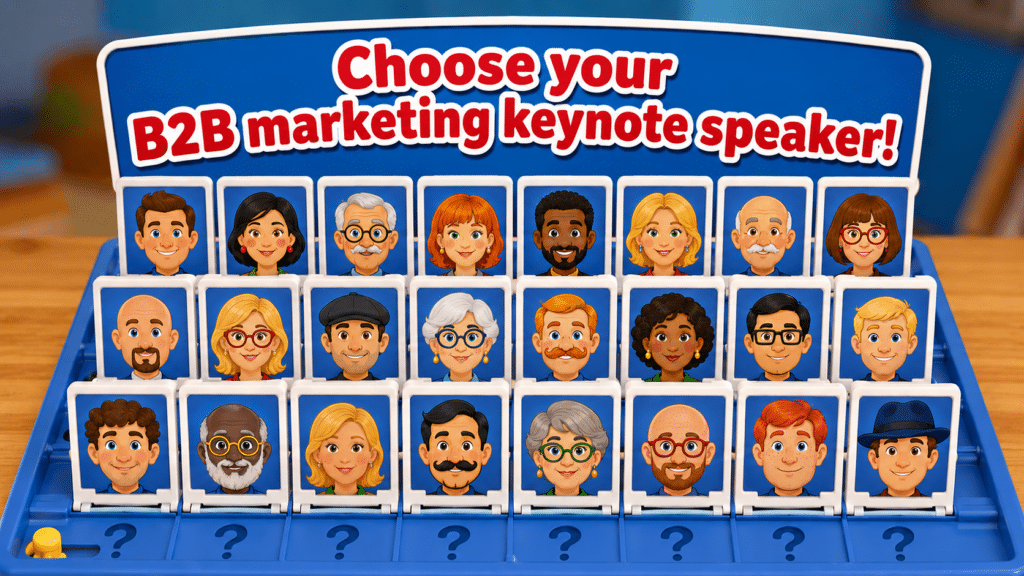
Choosing a keynote speaker shapes who registers, who turns up, and whether anyone remembers your event three months later. So why is the decision so often made on a LinkedIn follower count and a hunch? Six criteria for getting it right.
The keynote is the single most leveraged decision you make as an event organiser. It shapes who registers, who actually turns up on the day, what gets shared on LinkedIn afterwards, and — frankly — whether anyone remembers your event existed three months later. Get it right and you sell next year’s tickets on the way out of the room. Get it wrong and no amount of clever production design will rescue you.
And yet, for something this consequential, the decision is often made on remarkably thin grounds: a LinkedIn follower count, a recognisable name from an adjacent industry, a recommendation from someone who saw them speak once at a different conference. Having spent over two decades in B2B marketing — latterly seeing speaker selection from both sides of the equation, as someone who has programmed events and someone who now regularly gets booked to speak at them — I’d offer the following framework. Six criteria, in rough order of importance.
1. Demonstrable subject matter expertise
This sounds obvious, but the bar is higher than ‘they’ve worked in the space for a while’. You want someone with verifiable depth on the specific topic you’ve asked them to address — not the general field. A celebrated CMO who built a great B2C brand is not automatically the right person to talk to a room of B2B marketers about account-based marketing, however eloquent they are.
The test: ask for two or three specific, recent examples of the speaker engaging substantively with your topic — a published piece of research, a podcast appearance, a long-form article, a track record of working on the problem in-house. If everything they’ve said on the subject lives inside a single keynote deck, that’s a flag. Real expertise leaves a trail.
2. Demonstrable expertise as a speaker
Holding a room of 400 senior marketers for 40 minutes is a distinct craft, and it does not automatically come bundled with subject matter expertise. Some of the smartest people in our industry are, regrettably, dreadful on stage — either because they default to dense, slide-heavy explanations, or because they’re uncomfortable enough that the audience feels it.
Always watch video of them speaking before you book. Not a polished showreel — a full, unedited talk to an audience comparable to yours. Look for whether they hold attention without pyrotechnics, whether they can field a question without retreating into jargon, and whether the audience actually leans in. If you can’t find any video, take a reference call with another event organiser who’s booked them. The B2B events circuit is small; this takes one email.
3. Integrity and objectivity
B2B audiences have a finely calibrated radar for a sales pitch dressed up as a keynote, and nothing damages an event’s reputation faster than a speaker who uses the stage to plug their employer’s platform for 30 minutes. This applies equally to vendors, consultants and analyst-firm speakers — anyone whose day job creates an incentive to skew the message.
The point isn’t that vendor speakers are off-limits — some of the best practitioners in our industry work for vendors. The point is that you should establish, explicitly and in writing, what the talk will cover, what it won’t, and how product mentions (if any) will be handled. A speaker who pushes back on those guardrails is telling you something useful.
4. A genuine point of view
This is the criterion most often missed, and it’s the one that separates a memorable keynote from a competent one. Expertise plus speaking ability plus integrity will get you a perfectly serviceable talk. What makes a keynote actually land — the kind people quote back to you six months later — is a distinctive argument.
The best B2B marketing keynotes I’ve seen in recent years all had one thing in common: they made some portion of the room slightly uncomfortable, in a productive way. They challenged a piece of received wisdom, named something the industry had been politely ignoring, or argued for a position the speaker knew not everyone would agree with. Speakers who only restate consensus produce talks that are pleasant to sit through and impossible to remember. Ask candidates directly: what’s the argument you’re making? If the answer is a list of topics rather than a position, keep looking.
5. Willingness to tailor
Professional speakers tend to have a stock talk — sometimes several — that they’ve refined over dozens of outings. That’s fine, and often a good sign of craft. What you want to know is whether they’ll genuinely engage with your audience, your theme, and the other speakers on the bill, or whether they’ll deliver their standard set regardless.
A useful early test: send them a clear brief and see what comes back. Does the proposal reflect your specific audience and event theme, or is it a thinly relabelled version of something they’ve given twenty times? Are they willing to take a briefing call, look at the agenda, and adjust framing so their talk complements rather than duplicates other sessions? Speakers who decline this kind of preparation aren’t necessarily prima donnas — sometimes they’re just over-booked — but you should know what you’re getting.
6. Practical takeaways
B2B audiences are, by professional disposition, pragmatic. They’ve given you a working day. They want to leave with something they can actually use — a framework, a benchmark, a question to take into their next leadership meeting. The TED-style inspirational keynote, beautifully delivered but actionably empty, is increasingly resented in our segment of the events world.
This doesn’t mean every keynote needs to be a how-to. The best ones often work at a more strategic altitude. But there should be something the audience can do, decide, or stop doing as a result of hearing the talk. Ask candidates how they’d want the room to be different on Monday morning. The answer tells you whether they’ve thought about the audience at all.
A final thought on process
None of these criteria are exotic, and none require a huge budget to apply — they require time, and they require you to do the work before you book rather than crossing your fingers and hoping. The speakers who most reliably deliver are rarely the ones with the biggest fees or the loudest agents. They’re the ones who clear all six bars: they know the subject, they can hold a room, they’re honest about their angle, they have an argument worth making, they’ll engage with your specific event, and they leave the audience with something to take away.
Find that combination and the rest of the event organises itself.
Let's connect
Whether you’re looking for a speaker, collaborator, or advisor, I’d love to help you bring fresh perspective to your B2B audience.
Follow me on:


