B2B marketing in the age of AI: what every CMO needs to know

AI is rewriting the execution layer of B2B marketing. But the things that decide who wins – trust, judgement, operating model, human connection – are the things AI can’t do. This is what is actually changing, distilled from a year of conversations with some of B2B’s sharpest operators.
Talk to enough senior B2B marketers about AI and a pattern emerges: almost none of them lead with the technology. They lead with trust, judgement, operating models, and the people they are hiring and the ones they are not. That pattern is the real story, and it cuts against the prevailing noise. The vendor decks frame AI as a tooling race – adopt fast or fall behind. The practitioners doing the work tell a more useful story. AI is transforming how marketing gets executed. But because it makes so much of the work faster and more abundant, it raises the value of everything it cannot do. These are the shifts every CMO needs to internalise.
1. The buyer has already moved
A growing share of the B2B buying decision now happens inside an LLM before a vendor is ever contacted. By the time a name reaches the pipeline, part of the decision has already been made. The instinct – more content, faster – hits a relevance wall: the easier content is to generate at scale, the harder it is to stand out. The counterintuitive truth in the data is that the marketing working best right now is more human, not less. An analysis of hundreds of tech-sector entries to this year’s B2B Marketing Awards found the highest shortlisting rates going to the most human tactics – sensory, experiential and physical direct mail – in the most digital of sectors. The brands pulling ahead have stopped trying to persuade buyers and started creating the conditions for buyers to persuade themselves. When AI floods the market with competent, generated-at-scale content, genuine human relevance becomes the scarce asset.
2. It’s a competency problem, not an adoption one
Tools are no longer the bottleneck; Copilot, Claude and ChatGPT are a browser tab away. The hard part is using them well – prompting, and above all evaluating outputs critically. AI is excellent at producing 80 per cent of average; the human skill of knowing what the remaining 20 per cent looks like is now the differentiator. Which is why value comes from operating-model design, not tool choice. Build a strategy around platforms and you are on a treadmill of implementation and rebuild as the technology shifts. Build it around problems – defining the specific challenge and what success looks like before reaching for a platform – and the tooling questions resolve themselves.
3. Trust is the currency – and it’s being tested
Trust surfaces in three forms, each of which matters to a CMO. Trust in the data: ask executives whether they trust it and around half say yes; ask whether they would hand it to the CEO unchecked and almost none would. In that gap sits the “verification tax” – teams losing 30 to 70 per cent of their time assembling and reconciling data rather than using it. AI is the stress test, because it needs structured data, which most enterprises do not have; put AI on bad data and it gets worse, fast. Trust between the business and marketing: in a market of layoffs and restructures, it is being withheld until marketing proves its worth with evidence rather than narrative. And trust in the system: when an AI agent acts on a brand’s behalf, accountability still sits with the human and the governance, never the agent.
4. Trust is the currency – and it’s being tested
The teams making the fastest, most sustainable progress bring legal, compliance and IT in early and treat them as allies – and find the result is more confident progress, not slower. The most replicable version of the principle is almost mundane: baking brand guidelines into the AI tools themselves, so outputs land on-brand by default and reviewers spend their time on judgement rather than enforcement. The staging and sandbox disciplines that organisations built as a matter of course for the web barely exist yet for agentic AI. Building them is not friction; it is what makes speed safe.
5. The team is being rewired – watch the junior pipeline
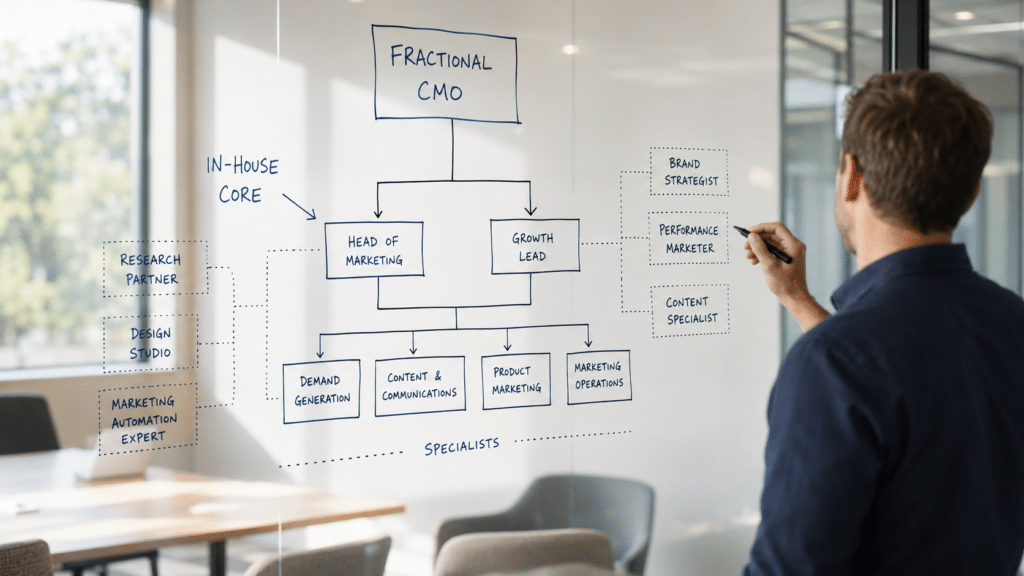
The shape of the marketing team is changing, and the change is structural. The routine middle – activation and execution – is compressing, while the strategic edges, orchestration especially, expand. Around this, work is being redistributed across fractional CMOs, lean internal teams and specialist freelancers. But the alarm sounding in nearly every conversation deserves to be the headline: cut junior hiring now because AI can do entry-level work, and you hollow out the pipeline that produces senior judgement in five to ten years. Those roles are where people learn to tell good from average – the very judgement that makes AI outputs useful. The organisations cutting entry-level roles today are the ones that will not have senior, AI-fluent talent in 2030.
6. Evidence beats narrative
The lag between marketing activity and proof of its value is collapsing. In the most advanced operating models, the ROI debate has stopped – not because ROI stopped mattering, but because daily go-to-market rhythms and shared metrics answer the return question before anyone asks it. Go-to-market, run properly, is a silo-buster, and the AI stack beneath it is downstream of the operating model, not upstream: without people working in a high-cadence, low-ego way, the technology is wasted. The corollary for every CMO is the measurement conversation – the more ambitious, more human work the market rewards needs permission from the CFO and CEO to operate across both short and long horizons.
The through-line
One idea connects all of it. AI moves the work; trust, judgement and operating model decide the value. The best results anywhere share a single feature: a skilled human in genuine partnership with the tools, applying judgement at the start and the end. For CMOs, that reframes the role – less the owner of campaigns, more the architect of the operating model, the trust architecture and the talent pipeline that let a leaner, AI-augmented team punch above its weight. The agentic era does not shrink the human role. It raises the value of the few things humans still do best.
Listen to the series
The arguments above draw on a series of conversations from the Trust & Influence in B2B podcast:
- Nick Eades – on private equity, go-to-market, and the end of the ROI debate.
- Maureen Blandford, Serendipitus – on the enterprise data health crisis.
- Angela Tangas, Oliver – on the four pillars of the agentic era.
- Andy Johnson, HUT3 – on orchestrating trust with AI agents.
- Kate Hassler, Access Group – on a year of AI adoption.
- Tejal Patel – on what the B2B Marketing Awards reveal about going to market.
- John Watton and Tom Howe – on the great reshuffle in marketing careers.
Let's connect
Whether you’re looking for a speaker, collaborator, or advisor, I’d love to help you bring fresh perspective to your B2B audience.
Follow me on:


