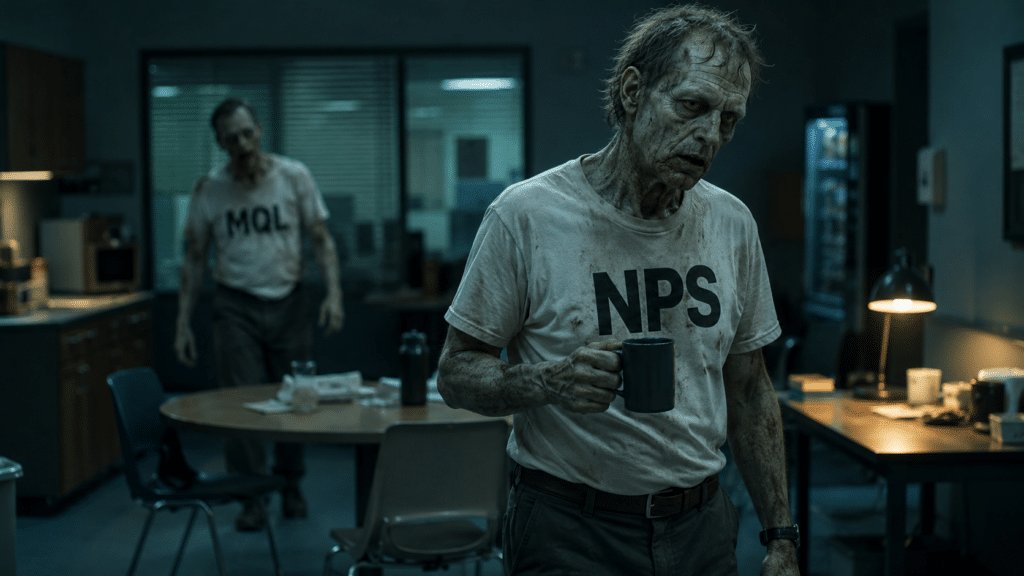
NPS RIP? Has B2B’s ultimate ‘zombie metric’ finally met it’s match?

Bain & Co.’s recently released ‘day one list’ methodology seeks to reframe the oldest debate in B2B measurement – the Net Promoter Score. On the Trust & Influence in B2B podcast, Tony Larks explains why NPS keeps surviving, how he built on Bain’s framework to create an AI shortlist tool — and why he’s giving it away for free.
NPS should be dead. B2B marketing has spent years trying to bury it — new frameworks, new loyalty scores, endless LinkedIn posts declaring its demise — and it keeps climbing back out of the grave. On a recent episode of the Trust & Influence in B2B podcast, I sat down with Tony Larks, a B2B marketing leader with over 20 years of experience across sales, enterprise technology and startup go-to-market, to talk about why NPS refuses to die, and what Bain & Co.’s newest research says might finally be worth putting alongside it.
Tony’s starting position surprised me. “I actually don’t think there’s anything wrong with NPS,” he told me. “It’s probably the things that are wrong in the way that people implement it, or think they can gamify it, rather than actually looking at it as root cause.” The number itself, he argues, was never really the point. “It’s not the numerical number. It’s actually how you relate it to the data behind it” — the free text, the reasons behind the score, and crucially, the people who never respond at all. Tony’s rule of thumb: if 100 people are asked and only 20 reply, the interesting story isn’t the score from the 20, it’s what the silence of the other 80 is telling you.
He illustrated the point with a story from his time in B2B financial services. Customers who paid a small monthly fine for failing PCI compliance were scoring the company NPS in the 20s and 30s — happy, even. Customers who’d been through the full compliance process, doing everything right, were scoring around minus 50. “It was almost like it was counterintuitive,” Tony said, “but it did make sense — the systems were so tough, the changes they had to make were so tough, it was cheaper just to pay the fine.” NPS wasn’t lying. It was just measuring something narrower than most teams assume, and segmented data was the only thing that made it legible.
The day one list
That’s the context for the research this episode was really built around. Bain & Co.’s recent paper argues that the real predictor of B2B growth isn’t loyalty at all — it’s whether a vendor makes a buyer’s “day one list,” the mental shortlist formed before anyone picks up the phone. Bain’s central, slightly uncomfortable claim: most deals that get logged as “lost” were never actually winnable, because the vendor was never seriously considered in the first place.
As Tony put it, reflecting on his own sales career, “we all know that it takes seven, ten, in my case seventeen active buyers to make a deal. If you’ve only got one, you already know you’ve got a gap.” Bain, working with LinkedIn, identified five things that get a vendor onto that shortlist: meeting current and future needs, value relative to total cost, being a safe and defensible choice, confidence in implementation, and ease of working with the vendor.
Building the shortlist matrix
The catch with Bain’s approach is that it’s built on first-party research — surveys, interviews, the kind of budget and time most marketing teams don’t have. “Everything we’re going to discuss later doesn’t replace first-party research,” Tony was careful to say. “If you’ve got the budgets and the support of your leadership team, I’d do the first-party research with Bain or anybody else all day long.” But most teams don’t have that luxury, which is what sent Tony back to work he’d already been doing for a year: building AI agents that track market and brand sentiment.
His answer was to take one company, find its ten nearest competitors, and run the same sentiment assessment across all eleven — pulling from analyst coverage (Gartner, Forrester, Omdia, IDC), peer review platforms like G2, forums including Reddit, and even employee sentiment on sites like Glassdoor. He then mapped the results against Bain’s five criteria to produce a simple two-by-two grid — confidence on one axis, day-one presence on the other — plotting every vendor from “strongest position” down to “invisible and weak.” He’s run it for close to 100 companies now, tested it against half a dozen other AI models to stress-test the results, and is giving the prompt away free. “If anybody needs it, I put it on my website — they can just scrape it,” he said. “There’s no money associated with it.”
The gaming risk
The obvious question is whether this just recreates NPS’s original sin at one remove — a score that’s easier to move than the thing it’s meant to represent. Analyst mentions, review volume, share of voice: all of these can be nudged with PR and content spend. Tony doesn’t dodge this. “The best way to fix the signals that probably have the most influence is to do a better job supporting your customers,” he said. “You can go and freak the system around PR, or post more on social, all day long. But actually the underlying principle is just do a better job servicing your customers.” His fix for the gaming risk is the same fix he’d apply to NPS: go after the root cause — product roadmap, response times, pricing transparency — rather than the signal itself.
Tony returned more than once to peer review platforms, and for good reason. G2 acquired Gartner Peer Insights in the last year, consolidating exactly the kind of third-party voice both human buyers and AI agents now lean on before anyone talks to sales. “These peer review sites are so core, so fundamental to B2B marketing in the future,” Tony said. “They are the engine for powering AEO and GEO — it’s the new SEO.” The practical implication loops straight back to NPS: find your nines and tens, and ask them directly to turn that into a review on G2 or Gartner Peer Insights. It’s one of the few honest ways to move the signal, because it still depends on someone having had a good enough experience to bother.
The hidden buyers
There’s one more layer worth pulling out, because it’s easy to miss in a conversation about scores and grids: the buyer you’re trying to influence usually isn’t one person. Bain’s framework, and Tony’s tool, both surface the “hidden buyers” — procurement, legal, end-users — who shape a shortlist as much as the named decision-maker does.
Tony has been here before, from the sales side. “Procurement, they’ve got a specific role, and it’s not just about driving down price,” he said. “They do a lot of assessment about capability and reputation and brand.” In his last senior marketing role, he made procurement part of the marketing team specifically to get ahead of this. Tony traced this back to sales methodologies he used earlier in his career, like Miller-Heiman’s “blue sheets” — mapping not just who signs off, but what each stakeholder needs professionally and personally to say yes. The point holds as well for AI agents as it does for humans: whoever, or whatever, is doing the research on your behalf needs to find evidence that speaks to procurement and legal, not just the champion who first made contact.
Two scores, not one
None of this makes NPS redundant. It measures something real and worth keeping — how the people who’ve already bought from you feel about it, provided you’re actually reading the free text and chasing the silence. What Tony’s shortlist matrix adds is a leading indicator sitting further up the funnel: are you even in the conversation before the conversation starts. Trust, in other words, isn’t one score. It’s earned twice — once to get considered, and again to keep the people who chose you glad that they did.
What to do with this
None of it needs Bain’s budget. It just asks you to look properly at what you already have, and to be honest about what the signals are telling you.
- Go back into your CRM and actually read the reasons deals went quiet — not just win/loss codes, but who the buyer was and where in the process they disappeared. That’s data you already own, and most teams have never mined it properly.
- Treat peer review sites (G2, Gartner Peer Insights and equivalents) as infrastructure, not an afterthought. They’re increasingly what both AI agents and human buyers read first, and turning your NPS promoters into reviewers is one of the most direct levers you have.
- Map your hidden buying group properly — procurement, legal, end-users — not just your primary contact. Bain’s research suggests these voices shape the shortlist as much as the named decision-maker does.
- Resist the temptation to game any of this with PR spend alone. Fix the product, service and pricing issues the signals are actually pointing at — the same discipline that makes NPS useful applies here too.
- Revisit your ICP and resist chasing deals outside it. Bain’s framework rewards focus: the accounts where you’re genuinely in contention beat the ones where you’re hoping to get lucky late in the process.
- If you want a starting estimate of where you sit before committing budget to proper first-party research, Tony’s shortlist matrix prompt is free — reach out to him directly for it, or watch the full episode for the details.
Let's connect
Whether you’re looking for a speaker, collaborator, or advisor, I’d love to help you bring fresh perspective to your B2B audience.
Follow me on:


