Craft is the new credibility

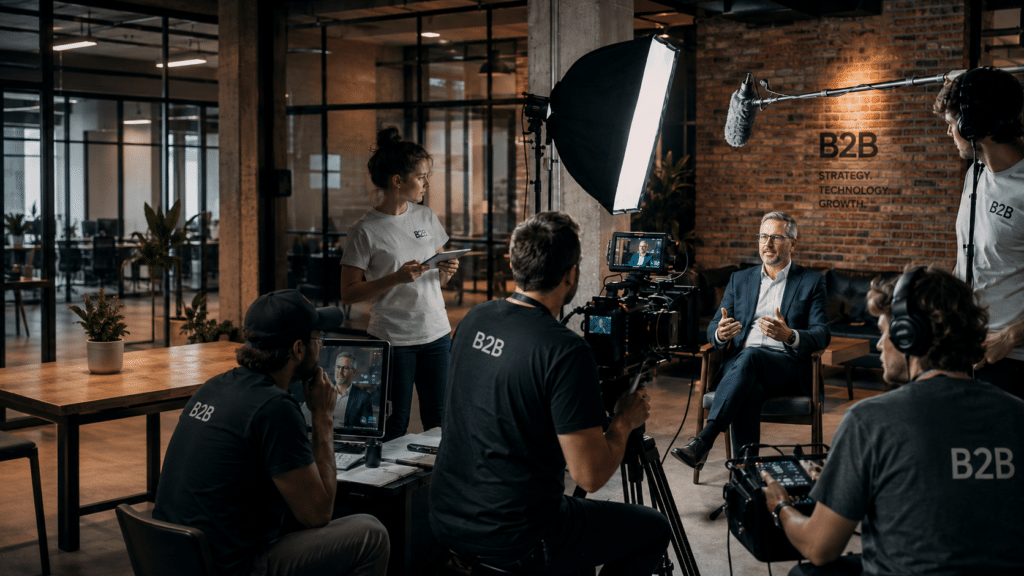
Consumer-grade entertainment is a powerful new trend in B2B, which I spoke about at B2B Ignite in July, and one which I thought had little connection with my core theme of trust. But how wrong I was.
For this year’s Ignite talk, I picked a subject that has almost nothing to do with the work I usually do. My territory for the best part of two years has been trust – thought leadership, advocacy, the mechanics of credibility in B2B marketing. “Lights, Camera, Pipeline” was a deliberate departure: two years of B2B Marketing Awards entries, taken apart to understand the rise of consumer-grade entertainment in B2B – cinematic film, documentary, serialised audio, immersive experience, gamification. Format and craft, not evidence and expertise. I chose it partly because it was unfamiliar ground.
The deep dive earned its place on its own terms. Across two years of UK entries, the brands pulling ahead had stopped asking “is this good for my B2B brand?” and started asking “would someone actually choose to watch this?” – a genuinely different question, and one with the data to back it. I built the talk, and the case for it, without expecting it to have anything to say about the trust argument running through everything else I do.
What I didn’t expect, finalising the deck, was to end up back on entirely familiar ground. Somewhere in the closing slides I wrote a line I’d already written once before, in a different context: craft is the signal AI can’t fake. An alien topic, and an unexpected alignment with the one argument I keep coming back to.
The argument I keep coming back to
I’ve argued elsewhere that trust has become the decade’s defining B2B problem because several forces collided at once – a wider collapse in institutional trust, a buying environment that’s slower and more crowded than ever, and, the one that matters most here, an AI content avalanche that’s degrading signal quality across every channel. Generative AI made content nearly free to produce. That sounds like an unambiguous win until you notice what it did to the value of any single piece of content: nothing, because supply is now infinite. The scarce resource stopped being information. It became confidence in which information, and which source, to believe.
The answer I’ve mostly given to that problem sits in thought leadership: the one thing AI can’t shortcut is visible human effort. Original insight, a distinctive point of view, evidence that someone actually did the thinking – that’s a competitive moat, as one person I quote often has put it, precisely because AI cannot fake having done it.
Where the alignment shows up
The entertainment data says the identical thing, just measured differently. Across two years of UK B2B Marketing Awards entries, use of entertainment techniques – cinematic film, documentary, serialised video and audio, immersive experience, gamification – rose from 22.3% of campaigns in 2024 to 30.2% in 2025. Campaigns using it were 21% more likely to beat their own objectives (37% versus 31%) and 2.5 times more likely to claim a record or first-of-its-kind result. And crucially, none of this carries a cost premium: median spend on entertainment-led work actually sits below the median for everything else, at roughly £95k versus £108k. Some of the strongest examples ran for under £25k.
Read the awards data as association, not proof – these are patterns among entries, not a controlled experiment. But the pattern is consistent, and it maps precisely onto the trust argument. Craft, story and production time can’t be generated at scale the way words can. A documentary takes months. A cinematic film needs a crew, a location, a director who cares about the shot. None of that is fakeable by a prompt. So in a market where synthetic content is cheap and infinite, visible effort becomes the differentiator – exactly the same mechanism that makes original thinking valuable when everyone else is publishing AI-assisted filler.
The audience’s vote is itself a trust signal
There’s a sharper version of this in consumer marketing, and it’s worth borrowing. The traditional advertising bargain was interruption: you pay to put your message in front of people who were trying to watch something else. Branded entertainment inverts that. Mattel didn’t fund Barbie – Warner Bros did – and consumers paid roughly $1.4 billion to watch what was, structurally, a two-hour advertisement for a toy company. LEGO ran the same play nine years earlier: The LEGO Movie made $468m against a $60m budget, the word “Lego” is never spoken on screen, and the company attributed an 11% sales jump in the following six months directly to the film. Red Bull took it further still and became a media company outright, licensing its own content to Netflix and Discovery rather than buying airtime from anyone else.
What connects these cases to trust isn’t the box office. It’s that nobody sits through two hours of something on the strength of a claim. An audience choosing to keep watching is a continuous, real-time trust decision – renewed scene by scene, with an exit always one tap away. That’s a far higher bar than tolerating a 30-second spot, and clearing it is only possible with work that earns attention rather than interrupts it. The choice to watch is itself the evidence.
A fourth technique, or the same one made visible
I’ve previously named three techniques that demonstrably build trust in B2B: thought leadership, advocacy and influencer marketing. I don’t think entertainment belongs on that list as a fourth, competing option. I think it’s the delivery layer underneath all three – the thing that turns any of them from an assertion into evidence. A case study is a claim. A documentary about the same customer is proof of the effort behind the claim. A founder’s LinkedIn post is a claim. A serialised, well-produced podcast built around genuine expertise is evidence sustained over time. Craft doesn’t replace the substance – it’s what makes the substance legible as real, rather than merely stated.
What this means in practice
The honest caveat here is the same one that applies to thought leadership: craft can’t rescue an empty proposition – it only makes the emptiness more expensive to discover. And half-committed craft may be worse than none at all. Work that gestures at production values without genuinely earning them reads as trying to look trustworthy rather than being it, which is its own kind of tell. Reach for it, in other words, when you have a real idea and you can commit to seeing the craft through – not as a substitute for either.
What I take from finding this alignment in a topic I didn’t go looking for it in is a small but useful correction to how I’ve been framing trust. I’ve mostly talked about it as a question of what you say and how well-evidenced it is. The entertainment research adds a second axis: how something is made carries as much trust signal as what it argues. In a market flooded with content nobody had to work for, the visible fact of the work is itself the argument.
Designing for trust, not hoping for it
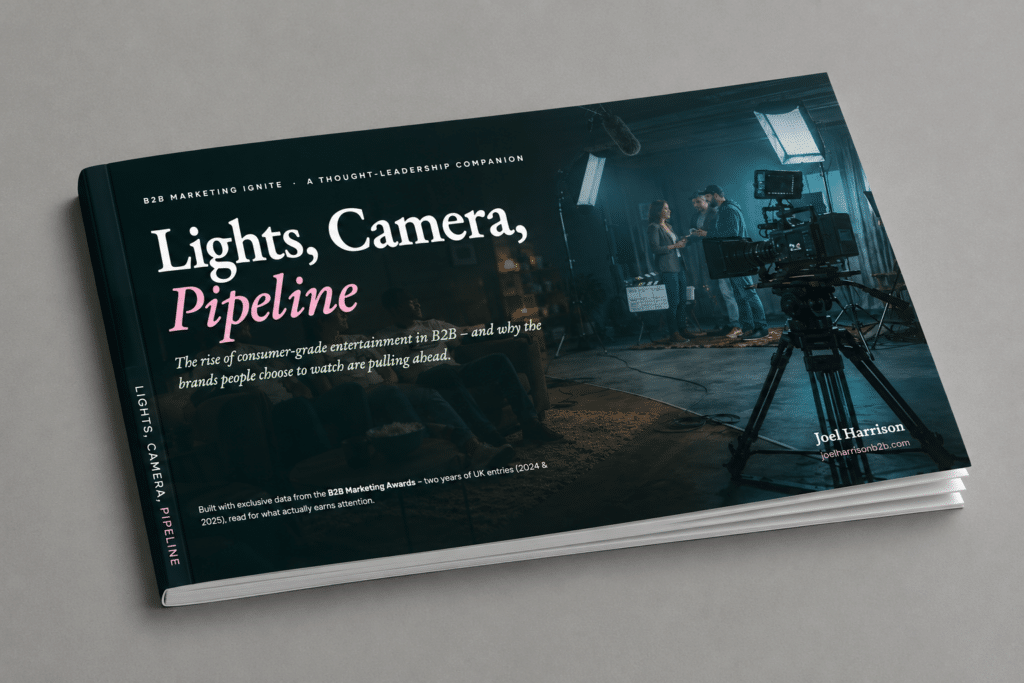
I didn’t set out to write the entertainment talk as a trust argument, and I’m slightly wary of retrofitting a thesis onto data that was gathered for its own purpose. But the throughline held up under scrutiny rather than dissolving, which is usually the test I trust. An alien topic and a familiar argument, arriving at the same place: in an AI-flooded market, effort is evidence – whether it shows up as an original insight or a two-hour film nobody was obliged to watch. You can download the report that I created to accompany my presentation here.
Let's connect
Whether you’re looking for a speaker, collaborator, or advisor, I’d love to help you bring fresh perspective to your B2B audience.
Follow me on:


