The truth about trust part 1: From centralised to atomised – why trust in B2B has a new owner


For a long time, B2B markets had a guardian of trust: a small number of publishers who vetted who to believe, so nobody else had to. That guardian is largely gone, and trust in B2B has a new owner. One piece in a wider look at trust in B2B.
Once upon a time, every B2B market had a clear, obvious guardian of trust: the vertical trade press, the publications that existed specifically to serve that market. That’s no longer true. Trust has undergone a gradual but massive shift over the past twenty-five years, and the consequences are only now becoming clear for all of us.
There’s a word for what happened to those guardians: disintermediation – the removal of the intermediary that used to sit between a buyer and the information they needed. It’s usually told as a story about decline: falling readerships, closed titles, cut budgets. That part is true. It’s also the least interesting part of it. The more interesting question is what happened to the trust that intermediary used to hold on everyone’s behalf. It moved – to new voices, new platforms, new places entirely – and it arrived in pieces, not as one intact block.
What happened to the guardians
What actually forced that change wasn’t a change of heart inside publishing houses. Readers wanted immediacy: flicking through a monthly issue for whatever a trusted editor had judged worth including gave way to searching for the answer to the exact question in front of them, right now. Advertisers wanted accountability: buying proximity to a trusted readership gave way to buying leads they could track directly, cost per click rather than cost per impression. Between the two, the economics that had funded independent editorial simply stopped adding up – and everything that follows is a consequence of that shift, not a separate story alongside it.
RELX’s own account of the period, published as “Stop the Press,” is candid about the result: after a 2009 crisis, Reed Business Information’s margin target was raised from 15.4% to 20%, and RELX disposed of 65 print titles through the 2010s – Farmers Weekly among them, in December 2019. Print fell from over half of RELX’s revenue in 2006 to 7% by 2020; its data and analytics division, meanwhile, was running at margins of 36.8%. It wasn’t decline so much as reallocation, in the company’s own words, toward whichever business line paid better. It hasn’t stopped: Crain Communications cut 25 jobs in November 2025, four of them named journalists at Automotive News; Informa TechTarget, publisher of MicroScope, cut 10% of its workforce in July 2025. Three headline cases, not a systematic survey of the whole trade press – illustrative of a pattern, not proof that every title or publisher has followed the same path.
It’s also not a uniform story, and it’s worth resisting the urge to make it one. The FT hasn’t declined the way Reed Business Information or Automotive News have – but that has less to do with editorial virtue than with market position. Its global reach and the breadth of its audience give it access to global brand budgets in a way a vertical trade title never could, while trade publications were always more exposed to swings in economic sentiment, and under far more pressure to prove a tangible return on the spend that funded them. Not every trade title has gone the same way either: some have thrived under new ownership, others have been deliberately migrated into communities or data products rather than left to wither. What’s consistent isn’t decline everywhere. It’s that, one way or another, most are now a smaller force in their markets than they used to be.
None of that is really the point of this piece, either. The point is what happened next – where that trust went, and what it turned into when it got there.
Where it went
So where did the trust go? Not nowhere. It moved – visibly, measurably – toward individual voices, and the platforms that carry them.
LinkedIn’s recent research with the B2B Institute and Ipsos, The Credibility Code, puts a number on the gap this has opened up: 94% of B2B marketers say trust is critical to their success, but only 45% trust the vendors they actually engage with. Most of the market is already trying to close that gap with content that doesn’t come from a brand at all – 82% of B2B buyers say creator content directly influences their purchasing decisions, and nine in ten decision-makers say strong thought leadership makes them more receptive to being approached in the first place.
I put a version of this shift to Katy Howell, CEO of Immediate Future, on the podcast, talking specifically about YouTube – a platform that’s quietly become the UK’s second most popular content destination, behind only the BBC, while just 21.2% of entries to this year’s B2B Marketing Awards used it at all. Howell’s phrase for what’s replacing the old model has stuck with me: “One face can spark the attention. But a chorus of credible voices builds trust.” A chorus, not a soloist. That’s exactly the shape of what’s stepping into the space the trade press used to occupy – not one big voice, but many small ones. It’s worth noting, too, that a chorus doesn’t work if every voice sings the same part – some carry the melody, some hold the harmony underneath it. Exactly which kinds of voice do which job in an atomised system is a bigger question than this piece has room for, but it’s one worth naming rather than assuming away: trust isn’t likely to be picked up evenly.
Reddit tells the same story from another angle entirely. As of this year, it’s reportedly the single most-cited domain across AI-generated answers – ChatGPT, Google’s AI Overviews, Perplexity and Gemini all draw on it more than any other source. When I talked to Luan Wise and Andy Lambert about what that means for B2B, Wise put it plainly: “It’s about community and it’s about each other having conversations and asking questions, and kind of self-monitoring.” Lambert took it further: “What other people say about you matters more than anything you’ll ever say about yourself” – always true in B2B, but sharper now that an AI engine, not a journalist, is often the one repeating it back to the buyer. A community thread, not a press release, is increasingly what shapes the answer someone gets when they research your category.
What atomised trust actually is
It would be easy to read all this as a straightforward swap – one set of trusted sources for another – and I don’t think that’s quite right.
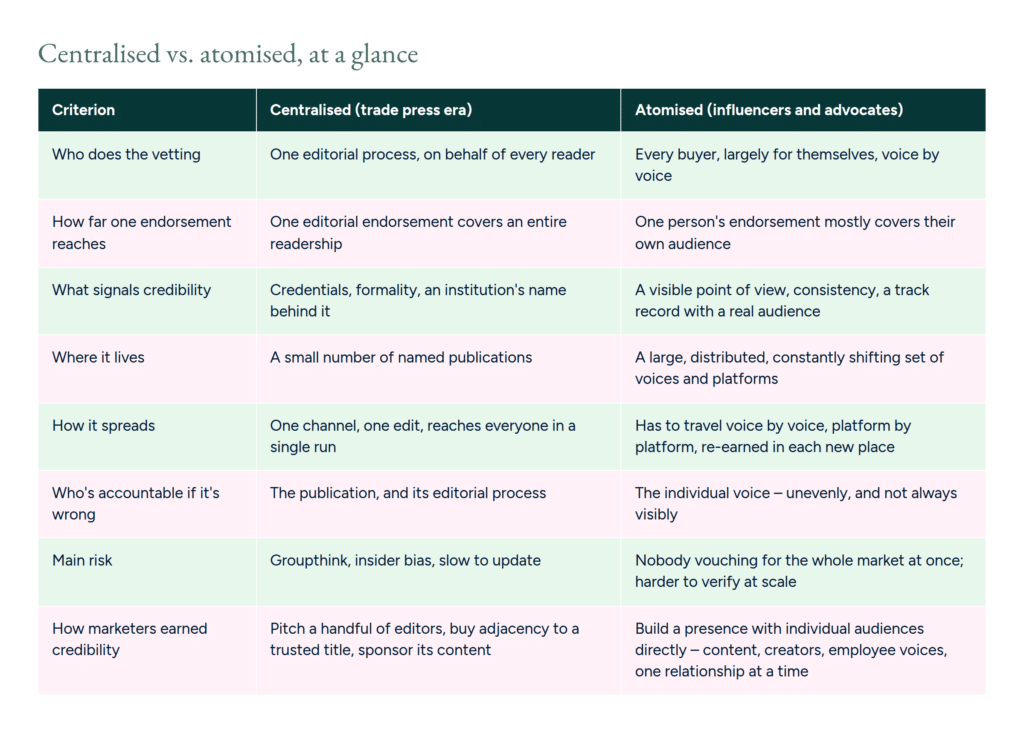
A trade publication’s editorial process did its checking once, centrally, on behalf of every reader who ever picked up that issue. One decision stood in for thousands of individual judgment calls. That’s what centralised trust actually was – not that the institution was infallible, but that it was doing the work of deciding who to believe, so nobody else had to.
What’s replacing it doesn’t work that way, and nothing is stepping in to make it work that way again. There’s no single new authority absorbing that function. Trust is being built voice by voice instead of institution by institution: some of those voices reach one buyer at a time, others – established creators and community figures with real audiences – reach plenty of people at once, but none of them vouch for a whole market the way a trade title’s editorial process once did. Wise made a related point about organisations, not buyers: “There’s a gap between those that get it, are absorbed in this world… versus those in the boardroom that are kind of asking questions about metrics and what’s happening.” Most companies are still resourced and structured for a world with a centre. The work of building trust hasn’t disappeared. It’s stopped being centralised, and started happening everywhere, continuously, one voice at a time – and a lot of B2B marketing hasn’t caught up to that yet.
That changes what actually earns trust, not just where it’s found. Content built for a centralised, one-to-many system rewarded institutional signals – credentials, formality, the visible apparatus of an editorial process behind it. LinkedIn’s own creator research offers a concrete read on what’s replaced that: on its platform, ads with an organic, user-generated feel see a median 52% engagement uplift over highly polished equivalents, and ads with a clear point of view see a median 40% uplift over neutral ones. Worth being clear-eyed about the source: this is LinkedIn measuring the ad products it sells, so it has its own commercial interest in personality-led content being the answer, and it’s one platform’s data, not independent proof that personality-based trust beats every other kind everywhere. But directionally, it fits everything else here: content that reads as one person’s honest judgement is doing better than content that reads as an institution’s official position.
The question that’s left
That’s what disintermediation actually looks like once the dust settles – not an empty space where the guardians used to be, but no single new guardian either. No single platform, publisher or AI engine is going to do for B2B buyers what the trade press used to do – vouch for everyone, all at once, invisibly, in the background. That job has been handed to a much larger, harder-to-map set of individual voices trying to earn it for themselves – some one relationship at a time, some at real volume and reach – with nobody vouching for all of them at once.
Most B2B marketing is still built to answer one question: how do we get noticed. Attention still matters – nobody’s arguing otherwise. But it’s a different question from the one this creates: with no single institution left to vouch for you in advance, and trust scattered across a far larger, harder-to-map set of voices than any one buyer can realistically track, what does actually earning it – deliberately, at whatever scale you operate at – now take?
So how else is B2B trust shifting, and what does that mean for B2B marketers? That’s something this series will keep exploring – subscribe to this newsletter for the next one, or to the Trust & Influence in B2B Podcast.
Let's connect
Whether you’re looking for a speaker, collaborator, or advisor, I’d love to help you bring fresh perspective to your B2B audience.
Follow me on:


