The future of B2B marketing teams: new models for a changing landscape

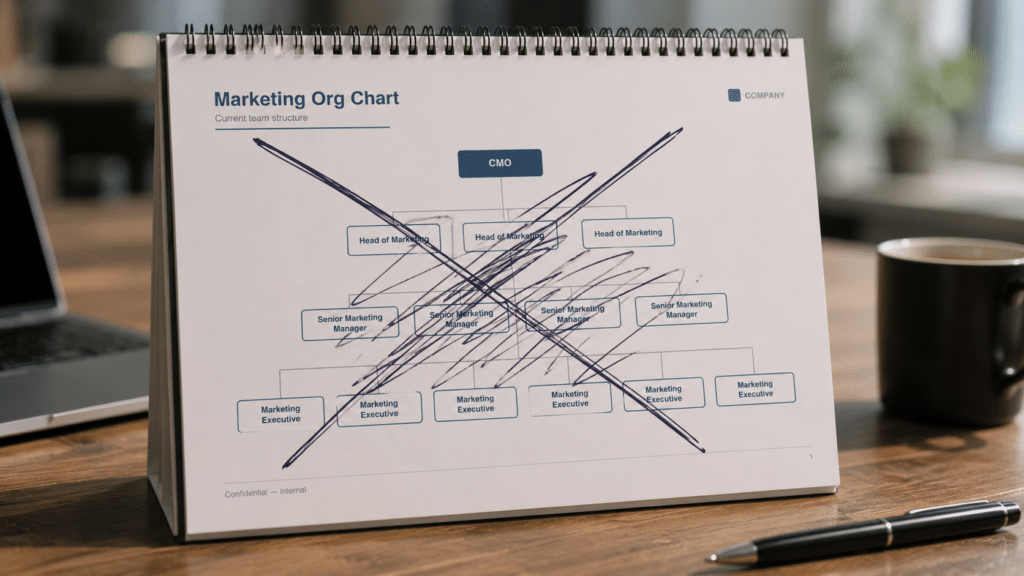
Marketing teams are getting leaner, budgets tighter and operating models more fluid. Look past the headlines and a more interesting story emerges — a profession redesigning its own shape, swapping fixed structures for flexible resource networks, and rethinking where trust in marketing should sit.
Over the past couple of years, something shifted in B2B marketing, and you can see it most clearly not in the campaigns but in the careers. Teams are getting smaller. Budgets are getting tighter. Roles are being rewritten or removed altogether. And many marketers — including very senior ones — are discovering that the recruitment market now runs on rules quite different from the ones that shaped their careers a decade ago.
Recruitment, though, is about more than jobs. It is a signal of trust. It shows what organisations trust marketing to own, what they trust it to influence, and what they no longer trust it with at all — or perhaps never did. Right now those boundaries are being redrawn under pressure from economic uncertainty, generative AI and a growing demand for certainty from boards and chief executives. Used as a lens, hiring tells us a great deal about where the function is heading.
To make sense of it, I drew on conversations from across the spectrum: senior client-side marketers, a specialist recruiter with a front-row seat on hiring, a charity leader who worries about who comes into the profession next, and a roundtable of corporate marketing leaders wrestling with the operating-model question directly. Their conclusions converge on a single, oddly reassuring idea: this is not the end of marketing. It is a reset — and the team that emerges on the other side will look quite different from the one we have known.
A correction, not a collapse
The first thing to say is that the panic is overdone — or at least mis-measured. John Watton, a B2B technology marketing leader who has been in and out of the senior market for two decades, does not sugar-coat it: the last two years, he says, have been the toughest he can remember for senior marketers. But he is equally candid that much of the bloat was real. “Some of the organisations I was part of were a little bit bloated and needed adjustment,” he admits. “When I talk to smaller businesses at the hundred-million-ARR level and they have a hundred marketers, even I say: what do all those people do? I have no idea.”
Tom Howe, who recruits senior marketers at Jefferson Locke, supplies the missing context. The slump only looks catastrophic because we keep comparing it to a freak high. “In COVID, recruitment went up astronomically. If you look at the charts, we were seeing 200% to 300% lift on activity from 2020 to 2023,” he says. “The numbers on job opportunities — we’re back to pre-2018, which is a fairly normal level.” The whiplash, in other words, is the story; people are reeling from one extreme to the other rather than confronting a permanent contraction.
Howe is careful not to coat it in doom and gloom, and Watton frames the whole episode as a rational, if brutal, course correction — one accelerated, but not caused, by AI. “It’s not the end of marketing,” he says. “It’s the opportunity to reset and build for the next phase.” His guiding cliche is the right one for the moment: build the team for the future, not the team for the past.
The trust problem marketing never solved
Strip away the cyclical noise, however, and you reach a more uncomfortable, structural truth: marketing has never properly proved its worth, and the bill for that failure is now falling due. Skip Fidura puts it with the bluntness of someone who has sat through too many conference agendas. “You and I have gone to all these conferences and there’s always one full session about how we speak the language of finance, how we prove the ROI,” he says. “If that’s coming up conference after conference after conference, clearly we are not doing it. And we haven’t done it well.”
The value of marketing is not understood. This is a way around and an end-around — so we have marketing, but we can get stuff done and marketing doesn’t stand in the way.
— Skip Fidura
Fidura’s warning is that this lack of understanding makes the function quietly disposable, and that marketing may not be the last to find out. “If you work in HR,” he says, only half joking, “I think you’re going to be next.” The corollary, heard repeatedly from marketing leaders themselves, is that the value case can never be considered won. As one senior marketer at the roundtable described it, the job is to “continue telling that story about the value that marketing is bringing to the business — we’ve got to really make sure that we’re telling our story effectively and demonstrating that value.” In a low-trust market, that storytelling is not vanity; it is survival.
The identity crisis: everything, now, for less
If organisations distrust marketing, it is partly because they cannot articulate what they want from it. Watton describes a hiring market in the grip of an identity crisis. “When I talk to companies looking for CMOs or marketing leaders, they really don’t know what they want,” he says. “It’s back to: we know it when we see it. They want everything. They don’t want to pay as much as they used to. People aren’t really sure what they want from marketing apart from everything.”
Two forces sharpen that confusion. The first is a relentless pull towards the short term. Howe hears it in every brief: “Everybody wants results yesterday.” Boards talk a good game about long-term brand-building, but their behaviour is pure jam today. The second is generative AI, which has handed non-marketers a deceptively simple yardstick. Watton has watched it land in interview rooms. “A CEO sits there going: why does it take you 90 days to write a marketing plan when I’ve just gone into ChatGPT and got one out in five minutes? These are real situations.” Against that backdrop, the perennial “how hard can it be?” suspicion about marketing has acquired fresh and dangerous force.
The consequence is paralysis. Search processes drag on for months and then quietly conclude with no hire at all — the team will “make do” while leadership works things through. Yet Watton insists the underlying need has not vanished. “The reality is they probably don’t trust marketers too much, because they don’t know what they want,” he says. “But if it clicks, they are still looking for someone they can trust to do the job.” The catch is that the marketer must now prove short-term impact in the first 30 to 60 days while quietly building the long-term plan — earning a “framework of trust” at speed.
The AI double-bind
Nowhere is the trust question more loaded than around AI, which has put senior marketers in an impossible position. The moment a leader argues that AI can produce a serviceable first draft but a senior hand is still needed to make it good, the argument curdles. “Instead of it being an ROI argument, it comes across as an anti-AI argument,” says Fidura. “You get painted as a Luddite. Meanwhile, the CMO making that argument is probably the most qualified person in the business at adopting AI tools — they’re being painted as anti-AI precisely because they understand the limitations.”
But several of the people I spoke to expect the pendulum to swing back. As the market fills with bulk-standard, machine-made content, the ability to stand out becomes scarce and therefore valuable. Howe foresees “AI fatigue,” where it grows harder to differentiate typical AI-generated work, and a corresponding return of trust “into human marketers who understand the nuances that AI can’t deliver on.” Watton frames the winning posture as orchestration rather than automation: “You’re using it as an intelligent tool, not something that’s autopiloting you somewhere you don’t want to go.” What people are realising, he adds, “is they do need a sprinkling of experienced people who can guide the AI and understand what good looks like.”
The winners will be those that harness that blend of AI and human ingenuity to differentiate and stand out.
— John Watton
The diamond and the squeezed middle
When you map these pressures onto an org chart, a distinctive new silhouette appears. Howe calls it a diamond. “We’re back into seeing more senior-level hires coming in, with businesses wanting more immediate results,” he says, “but we’re seeing less at the junior levels — and a blown-out middle management trying to pick up the pieces in between.” Watton recognises the shape instantly and gives it a more human name: the squeezed middle. “We’re asking a lot of middle managers who have some experience, but maybe not enough, to do the more strategic stuff,” he says, “with no team, no administrative support, pulled in every direction — it has to be strategic, then it has to do stuff.”
That squeeze sits on top of a slow-burning structural risk. The junior rung of the ladder is being pulled away just as the middle is asked to carry more. Graduate schemes and internships have been quietly cut; the routine content and workflow tasks that once trained newcomers are increasingly handled by AI. Howe is blunt about where that leads. “We haven’t seen the usual burst of graduate programmes,” he says. “The managers for tomorrow, in three years’ time, they aren’t going to be there.” Watton sharpens the point: many jobs now demand “10-plus years’ experience,” yet a marketer who is only ten years in has likely never led a team through a recession or a downturn — a tall order just as the economy turns genuinely critical.
There is a hardening preference, too, for specialists over generalists. “If you come with actual industry knowledge that’s relevant to what the client’s trying to achieve, that’s point number one,” says Howe. The logic is rational — hire people who can hit the ground running — but it carries a cost. As Watton notes, the appetite for instant relevance can crowd out the broader, strategic operator who could actually grow the business over time. Marketing should be the long-term growth driver, not the short-term activation lever; the current market too often forgets it.
From organograms to resource networks
So what replaces the big, fixed, in-house department? When a group of corporate marketing leaders sat down together recently to thrash out the operating-model question, the striking thing was how far the debate had moved — from whether the old model is broken to how the new one actually works. Consultant Shane Redding, who chaired the session, framed the shift starkly. “Fixed operating models, trying to design for the future, just are not going to work,” she said. “We need a much more flexible, robust networking approach, rather than a structure with people in one role.” What excited her most was that the room had finally got past the problem statement: “There was a real understanding of the how to do it.”
The clearest articulation of that how came from Roland Glass, whose firm helps marketing teams build exactly these flexible resource models. The move, he argued, is away from “the previous blunt instruments of overly rigid organograms and org charts to a far more agile way of accessing the right talent for the job when you need it” — the right skills, in the right market, and, crucially, for the right amount of time. “Building resource networks as opposed to organograms gives them the ability to pivot,” he said, “to respond and change a lot faster than five or ten years ago, with an on-premise team or an overly rigid structure that’s hard to shift.” Resource network, not organogram: it is the neatest summary of where team design is heading.
Crucially, this is not change for its own sake but change anchored in the business. One participant, a global marketing leader, argued that the starting point is alignment: marketing proving it is “a key growth component within the business” before it earns the right to redesign itself. From there the questions become structural — how much resource sits centrally versus in the field, specialist skills versus generalist ones, and above all whether the structure can scale and flex. “We don’t know what we don’t know,” he said. “Can it scale? Can it flex? Can it be a different delivery model?” AI belongs in that picture too, not as a headcount substitute but woven into processes today while the team keeps the freedom to innovate into new ways of working tomorrow.
Underpinning all of it is a sober acceptance of the new economics. Another marketing leader captured the mood: align the operating model to the commercial objectives of the business, future-proof the team’s skills and technology, and build in enough agility “to scale up and respond to business needs without massively impacting your costs.” The era of abundance is not coming back. “I don’t think we’re ever going to get back to the days where we were all flush with budget,” she said. “That’s the norm.” The discipline now is to be flexible and resilient inside a permanent resource constraint.
That raises a softer but equally important challenge: how to keep a more fluid, distributed team feeling like a team at all. For another participant, the craft lies in the mix — covering the business-as-usual work, sustaining innovation, and holding the whole thing together across geographies. The valuable, practical ideas she took away were less about structure than about cohesion: “how do we share ideas across our team and keep those connections going,” keeping people focused on high-value marketing even as the org chart loosens beneath them.
John Watton offers a lived blueprint of what such a network looks like in practice. At its centre sits a small in-house core; into it he plugs as a fractional leader — brought in to “join the dots, build a strategy, put in measurements and show the impact of what marketing is doing” — alongside two or three specialist freelancers for paid media, SEO or copywriting, with agencies and, increasingly, offshore and external specialist teams engaged for defined periods as the work demands. The fractional leader is the genuinely new ingredient, and the economics are compelling. “Those companies like the idea of getting part of a senior person, because they get a lot of bang for their buck,” he says. “And senior people like me are supercharged by AI — so you get even more John for your money.”
One corollary deserves a flag, because it reshapes a relationship the industry has long taken for granted. As internal teams shrink and flex, the point at which they reach for outside help is shifting too. The old binary — a fixed agency team bolted permanently alongside a fixed client team — is giving way to something more fluid, with agencies and external specialists engaged for defined campaigns or periods and plugged into the network rather than running in parallel to it. Quite what that means for the agencies on the other side of the relationship is a substantial question in its own right, and one for another day.
What endures — and what the industry owes the next generation
For all the structural upheaval, there is striking agreement on what does not change. Martin Troughton, chairman of the Marketing Skills Trust, has lived through enough technology waves to keep this one in proportion. “AI is another new thing,” he says. “Electricity was going to be the death of most things. Trains were going to be the death of everything. Everything new is always extolled in that manner — but we calm down and we get there.” What survives every wave, he argues, is the human core of the craft: “Storytelling is universal. Understanding humanity is one of the greatest assets a marketer can have.”
That is also where the long-term threat lies. If junior roles vanish and entry narrows, the profession starves itself of exactly the human talent it will most need. Troughton’s worry is not only about volume but about variety. “The greater the diversity in the room, the greater the ideas,” he says, “but one of the barriers is that it’s about who you know, not what you know. There is such a diversity of roles, yet there isn’t a diversity of people — and there really should be.” In a world where AI is busily homogenising output, diverse human thinking stops being a nicety and becomes the differentiator. His plea to the industry is simple: stop putting people in boxes — too old, too young, wrong school — and widen the door. The pipeline problem, in other words, is a choice rather than a fate, and apprenticeships, retraining and outreach are levers the industry can still pull.
For individual marketers navigating all of this, the advice from those who do the hiring is consistent and clarifying. Lead with impact. “Everybody wants growth, so everything is about impact — what impact have you made?” says Howe, urging marketers to keep case studies of outcomes, even from restructures and tough decisions. Watton’s three-part version: link everything you do to business impact; stay curious and keep bringing new ideas; and, for a profession built on communication, work on the confidence to tell your own story well. “Think about how you can confidently tell the story about yourself,” he says, “and have a story, and work on that.”
Put it all together and the future of the B2B marketing team comes into focus. It is leaner and more senior at its core, more fluid at its edges, organised as a resource network rather than an organogram, and more dependent than ever on a small number of experienced people who can set strategy, orchestrate a shifting mix of human and machine resource, and prove their commercial worth in weeks rather than years. The pressures are real and the disruption is genuine. But as that roundtable of marketing leaders discovered, the conversation has finally moved from whether to how — and that, as Shane Redding put it, is the real breakthrough. The task now is less to mourn the marketing team of the past than to design — deliberately, and with an eye on who comes next — the one the changing landscape actually needs.
Let's connect
Whether you’re looking for a speaker, collaborator, or advisor, I’d love to help you bring fresh perspective to your B2B audience.
Follow me on:


