Is your client trust battery on charge, or is it nearly empty?

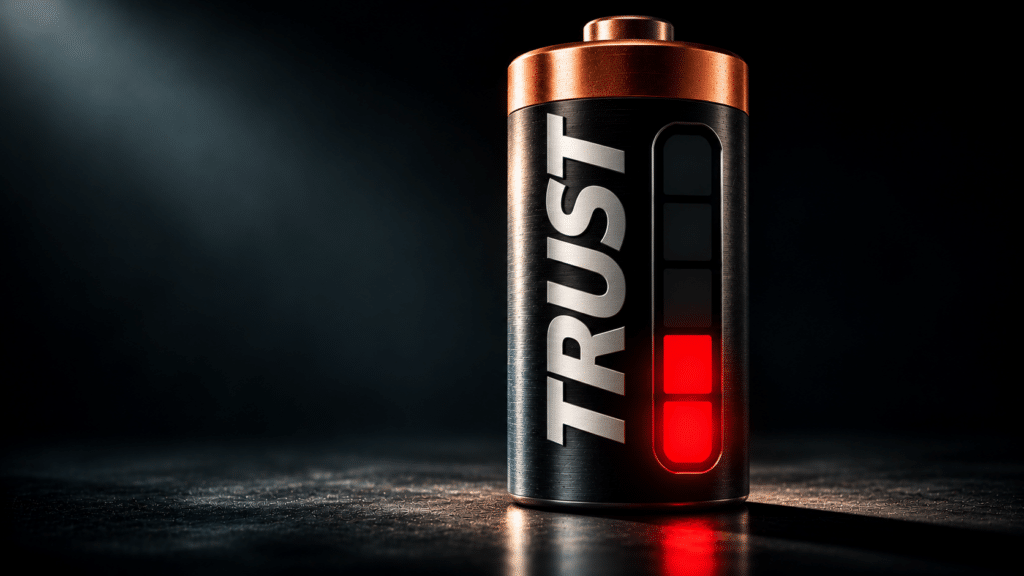
Most B2B companies pour everything into winning a customer’s trust, then quietly let it go flat the second the deal is done. Former Forrester analyst Megan Burns argues we should treat customer trust like a battery, one we have to keep charging through positive engagement, because when it’s empty, the client churns.
Picture every customer relationship as a battery. Each interaction, a quick reply, a missed call, a smooth renewal, a support ticket left hanging, charges it a little or drains it a little. Most B2B companies spend heavily to charge that battery once, during the sale, and then stop paying it any deliberate attention the moment the contract is signed. Megan Burns, founder and CEO of Experience Enterprises, has built the next stage of her career around the part everyone else stops watching: what happens to that battery afterwards.
This article is based on a recent conversation with Megan on the Trust & Influence in B2B podcast, where she talked through what her years inside Forrester Research’s customer experience practice, and inside the wider industry now racing to sell trust as a research category, taught her about how trust is really built, how it quietly erodes, and why the current wave of interest in measuring it, from Deloitte to Bain to the Financial Times, is genuine, but is only half the story.
The post-sale blind spot
Burns’s own interest starts at the point most sales and marketing conversations stop: the moment the contract is signed. “Up to that point it is to a certain extent on faith, even if you have evidence,” she says. “But once the deal is signed, you’ve got a certain level of trust, but that trust is now yours to lose.”
The pattern she hears about constantly from clients is familiar to anyone who has watched a supplier relationship cool after signature: attentive through the sales process, attentive through onboarding, and then, in her words, “the bottom drops out” until the account team resurfaces as everyone’s best friend at renewal time. It is a pattern with a commercial cost attached. Far more value sits in retention and expansion than in winning the next new logo, yet it is the stretch of the relationship that gets the least sustained attention.
The trust battery
She describes trust as something closer to energy stored in a battery than a single score. Every experience nudges it up or down a little, and when a customer next has to make a decision or a recommendation, they are drawing on the accumulated charge rather than any one interaction. One bad experience that looks like an anomaly rarely breaks that charge on its own. A pattern of them will.
That distinction between a person and the organisation behind them matters more than it first appears. Burns has interviewed account managers who were genuinely excellent at building trust, and who still left their employer when the company’s own actions made it impossible to keep representing it to clients in good conscience. Trusting an individual, however deeply, is never quite the same as trusting the business that stands behind them.
That accumulated charge, Burns says, is built from three different kinds of evidence, and marketers tend to live in only one of them. The first is association: assumptions people make based on your industry, geography or sector before they have any direct dealings with you at all. She points to pharmaceutical companies in the US as an example of an industry starting from a trust deficit most individual firms never personally created. The second is stories: the testimonials, reviews and word of mouth that shape an opinion of a company someone has never actually dealt with, which is where most marketing activity lives. The third, and the strongest, is personal experience. Ask someone whether they trust Amazon, a consumer example, but the same three-part test holds just as well in B2B, and they will have an answer; press them on it, and it usually comes down to whichever of those three kinds of evidence they happen to be holding onto most strongly.
An analyst’s view of the B2B trust industry
Having spent years inside one of the firms now racing to sell trust as a research category, Burns has an unusually clear-eyed read on the current wave of frameworks from Forrester, Deloitte, Bain and the Financial Times. She does not think the interest is new, and she does not think it is cynical. What she does flag is a “myth of infinite measurability”: the assumption that trust can be reduced to one clean number. In her view, a good framework earns its keep by giving an organisation a shared language for which parts of trust actually matter to its customers, not by producing a single definitive score.
Brand trust and individual trust sit closer together in the analyst world than almost anywhere else in B2B, and Burns has felt both sides of it. Early in her career at Forrester, she walked into a vendor conference in a market she barely knew, and people wanted her opinion anyway, purely because Forrester was printed on her name tag. “I don’t know what I think yet,” she remembers thinking at the time. The firm’s brand had already done the work of earning trust that she, as an individual, had not yet earned herself. Over time, she built the kind of relationships with vendors that mattered more: ones oriented around serving a shared client well, rather than around how much coverage a vendor could extract from an analyst report.
Credibility, in her experience, comes down to two separate tests. The first is simply whether the organisation behind a framework did the research properly. She points to Deloitte’s Four Elements of Trust as an example: having read the book and traced the process behind how the firm settled on its model, she recognised the same rigorous process her own team used years earlier to build Forrester’s Customer Experience Index.
The second test, which she finds people overlook, is whether a framework’s language will actually land inside your own business. She has watched a door close on a presentation the moment she used the word “humanity” as a variable, in an organisation where that language was never going to fly; sometimes the more useful word is “confidence” rather than “trust”, because it carries less of the moral charge that makes people defensive. Getting definitions straight matters just as much internally. Burns recalls telling a client that “executive alignment around priorities” meant nothing on its own; what the business actually needed from its leadership team was agreement to commit resources. Executives who never agreed to that specific commitment do not experience missing it as broken alignment. The people waiting on them experience it as a broken promise.
The commercial case for B2B trust
B2B trust’s commercial value is real, Burns argues, but it rarely shows up as a single deal won or lost. She calls the effect a “trust tailwind”: meetings happen more easily, negotiations are less contentious, and customers stop escalating every small issue because they believe the people involved will sort it out.
The inverse of that tailwind is just as real. Stephen Covey calls it the “trust tax”: the extra friction and cost that low trust quietly adds to everything an organisation tries to do. Neither effect announces itself in a single quarter’s numbers, which is exactly why trust is so easy for a business to under-invest in.
The biggest failure
Asked for the biggest trust failure she sees in B2B relationships today, Burns points first to a gap in motives: whether customers believe a company is genuinely acting in their interest, not just its own. She cites a customer advocacy metric her colleague Bill Doyle once built specifically to test this, asking customers whether they agree that “this company does what’s best for me, not just what’s best for its bottom line”. The scale of the blind spot shows up starkly in PwC’s trust and business research, which found that 90% of CEOs believe their customers have high trust in them, against only 30% of customers who agree. [PwC trust and business study link]
Beneath that sits a more mechanical failure: consistency. Delivering the same standard of treatment across a workforce of five or ten thousand people, in different departments and regions, is genuinely difficult, and plenty of large organisations have not done the work required to achieve it. The nuance Burns draws out is an important one: consistency does not mean treating every customer segment identically. If one segment has its own dedicated website and contact centre, it is entirely reasonable for its experience to differ from another segment’s. What does have to be consistent is anything the two segments actually share.
Where the risk is heading
Burns sees the next phase of this problem arriving through AI, and on two fronts at once. The first is accountability: when an AI system says or does something wrong, responsibility is still largely unresolved, and Forrester itself has predicted billions of dollars in lawsuits over exactly this question. The second is compounding misinformation. She describes a case where an AI system hallucinated that a company was under state investigation. It never happened, and the company proved as much, but the claim had already spread into online communities before it could be corrected, and by the time it was debunked the business had lost roughly $2.5 million in trade. Fixing the error did not undo the damage the rumour had already done.
The tools and the vocabulary around trust keep changing. The underlying discipline Burns is describing, building B2B trust deliberately and defending it after the sale rather than assuming it will hold on its own, has not.
Charging your own B2B trust battery
Her own advice for where to start is refreshingly unglamorous, and it holds up well as a short checklist for any B2B marketing or customer leadership team.
- Start talking about trust explicitly inside your own organisation, rather than leaving it as an unspoken worry that employees and customers are already carrying anyway. Burns has seen this alone open up conversations that leadership teams had been avoiding for years.
- Go back to the metrics you already collect and re-read them through a trust lens, before reaching for a new scorecard or framework. In most organisations the data needed to spot where trust is strong and where it is weak already exists; it has simply never been looked at that way.
- If the word “trust” puts people on the defensive in your organisation, reframe the conversation around “confidence” instead. Burns uses this substitution deliberately with clients, because it tends to surface the same honest answers without triggering the sense that someone is being personally accused of dishonesty.
- Give renewal and expansion conversations the same sustained attention as the sales process, not just a check-in once the contract is close to lapsing. This is where Burns sees the most quiet trust erosion happen, and where it does the most commercial damage.
- Treat an account manager’s individual credibility and your organisation’s credibility as two separate things that both need active investment. A strong account manager can only carry a relationship so far if the company behind them keeps falling short of what was promised.
You can listen the podcast interview with Megan Burns via the link below.
Let's connect
Whether you’re looking for a speaker, collaborator, or advisor, I’d love to help you bring fresh perspective to your B2B audience.
Follow me on:


