Why ‘honest’ beats ‘perfect’ for successful B2B pitches

Why do capable, well-run B2B businesses keep losing deals they should win? A new report called ‘The Trust Advantage’ has a name for it: the commercial credibility gap. On the Trust & Influence in B2B podcast, author Lorraine Emmett reveals the factors that are really derailing the deal and undermining B2B trust – and most importantly, what leaders can do about it
Your biggest competitor isn’t always a better business. Often, it’s simply one that’s easier to believe.
That’s the uncomfortable conclusion at the heart of the second year of the Trust Advantage research from 💫Lorraine Emmett, founder and managing director of Emmett & Churchman | B2B | Strategic Comms & PR, who joined me for a sponsored episode of the Trust & Influence in B2B Podcast to talk through what it means for B2B leadership teams. The study surveyed 200 senior UK technology decision-makers, evenly split across defence, IT and technology, manufacturing, and science and engineering, and sat down with 19 CEOs navigating real, high-stakes buying decisions of their own: supplier, partner and adviser choices across technology, private equity, refinancing, executive search and more.
What it found is that capable, well-run businesses lose deals constantly, not because they lack capability, but because of what the research calls the commercial credibility gap: the distance between what a business can deliver and what a buyer can see, believe and defend. As Emmett put it to me, “capability exists inside the business, credibility exists in the mind of the buyer, and you have to have both.” A business can be excellent at what it does and still fail to get chosen, because being good and being seen to be good are two different problems.
The gap is bigger than most leadership teams assume
The scale of it is worth sitting with. 45% of the senior buyers in the research said they’d ruled out a supplier, or not even put it on a tender list, because it failed to prove its own credibility. That’s not a pricing problem or a capability problem. It’s a trust problem, and it’s happening before a sales team ever gets into the room.
Across the conversation, Emmett kept returning to three questions she argues sit underneath almost every B2B buying decision: can I see it, do I believe it, and can I defend it. Can a buyer easily find evidence of what a business is actually good at. Does that evidence hold up once they look closely. And once they’ve decided, can they explain and justify that choice to everyone else who wasn’t in the room.
The research doesn’t rank these three questions against each other, and Emmett was careful not to claim it does. But together they’re a useful lens for diagnosing exactly where a credibility gap is opening up in a specific deal, and each one, as the sections below show, tends to fail for a different reason.
Overpromising costs B2B trust more than candour does
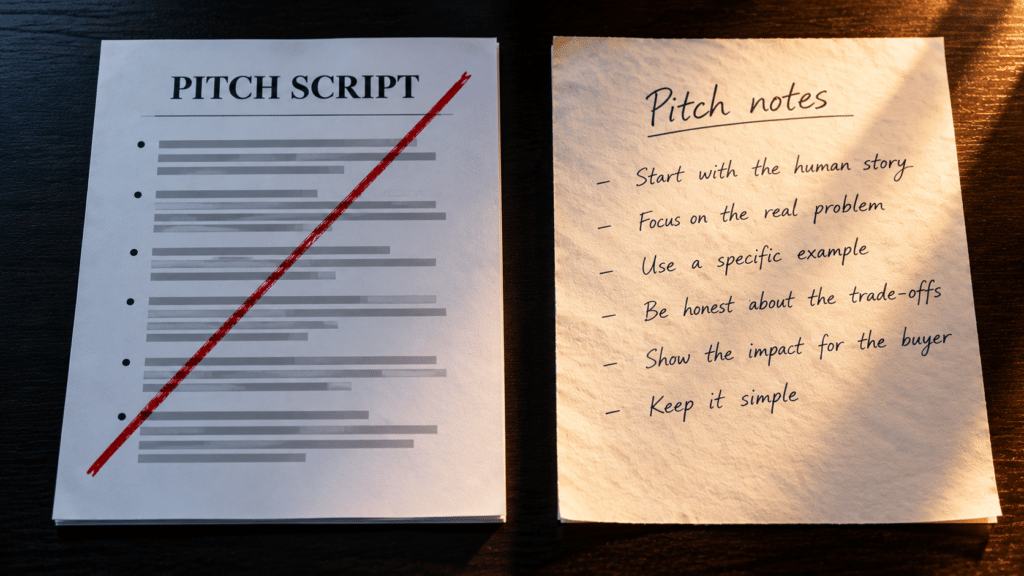
The research surfaces a tension that cuts against a lot of instinctive commercial behaviour: the urge to look invincible is exactly what erodes B2B trust. Over-promising without proof came out as one of the biggest destroyers of confidence in the research, while a clear, honest conversation about limitations and risk was one of the strongest confidence signals tested.
That’s a harder sell internally than it sounds. Most commercial teams are trained to project certainty, not to volunteer their own weak points. The research suggests the opposite instinct is the more effective one: naming your limitations before the buyer finds them builds more trust than a flawless pitch ever will, because a buyer who hears no caveats at all tends to assume they simply haven’t been told them yet.
Credibility isn’t confined to what a business puts out in its marketing, either. The research is explicit that it’s demonstrated just as much by how quickly a supplier responds, the questions it asks, the people it puts in front of the buyer, how it negotiates, whether it challenges constructively, and what it does when something goes wrong. The promise and the experience need to agree, or the gap reopens in the room itself, regardless of what the case studies say.
Winning the buyer isn’t the end of the job
One of the CEOs in the research described a private equity decision where the highest financial offer didn’t win, because confidence in the people, continuity and cultural fit outweighed the extra upfront value on the table. “It was the majority of the decision, whether I could trust them or not,” they told the researchers. “We were offered significantly more money, but never once did I think that made us question the choice.” That’s trust working as intended, on the person who holds the relationship.
The harder problem is what happens once that person has to take the decision somewhere else. When respondents were asked what blocks a supplier they already trust from actually being chosen, 43% cited finance concerns, 42% security or compliance objections and 41% operational disruption. More than a third, 35%, cited leadership preference for a more established name, and smaller shares cited a lack of time to manage the change or difficulty articulating the business case internally. Another CEO explained that market credibility becomes particularly valuable once a decision reaches the board, because those directors haven’t experienced the supplier the way the people running the evaluation have.
As the research puts it: a pitch cannot travel, but proof can. A strong relationship with your champion inside the buying business can create false confidence, because they may be convinced while the wider organisation isn’t. The practical implication is straightforward: don’t stop once your contact says yes. Ask what happens next, who else needs to agree, what will concern them, and what evidence they’ll need to carry the decision through the business without you there to make the case for them.
The challenger’s advantage is real, within limits
For smaller or less recognised B2B businesses competing against bigger names, the research offers genuine encouragement. 57% of senior technology decision-makers say they are likely or very likely to choose a lesser-known supplier over an incumbent if they trust it more. As one CEO in the research put it, “bigger isn’t always better. It’s better, better is better. And if you can demonstrate that value, that drives trust.”
There’s an important caveat. 30% of respondents say the decision depends on context, and when the stakes rise, 86% say trust and credibility become more important, not less. The opportunity for a challenger isn’t persuading buyers to ignore risk. It’s reducing it, through relevant case studies, references, visible expertise, a clear implementation plan and candour about risk. You do not need to look bigger than the incumbent. You need to make choosing you feel sufficiently safe.
B2B trust is a leadership issue, not a marketing one
Emmett’s research pushes back on the easy conclusion that marketing simply needs better case studies, or that sales needs stronger proof points. That’s too tactical. The commercial credibility gap exists when the business the market sees and experiences doesn’t provide enough evidence of the business that actually exists, and closing it takes alignment across leadership, sales, marketing, delivery and operations, not a single function fixing it alone. One CEO in the research was blunt about what happens when leaders opt out of that work: “it sends a really poor signal if the leadership sort of doesn’t bother to show up.”
The research includes a practical tool for leadership teams to test themselves against this directly: a ten-question commercial credibility test, split across the same three questions to consider around B2B trust. Can they see it, will they believe it, and can they defend it, each answered yes, not sure or no from the buyer’s perspective rather than from what the business knows to be true internally. Every “not sure” deserves investigation. Every “no” is somewhere confidence can break, and neither gets fixed simply by saying more loudly that you’re good at what you do.
It doesn’t hand leadership teams a longer marketing to-do list, either. It points to four priorities: make your expertise easy to recognise, rather than assuming buyers will work hard to understand what makes you different; put proof behind the promises you make most often, and ask what you’d show a sceptical buyer who said “prove it”; treat behaviour, not just published material, as evidence, since the promise and the experience of working with you need to agree; and equip your champion with what they need to defend choosing you once you’re no longer in the room.
Your biggest competitor isn’t a better business. It’s simply one that’s easier to believe. The leadership challenge, Emmett’s research argues, is making sure that isn’t why you lose.
What to do with this
If you’re taking one thing from this into your next leadership meeting, make it this.
- The commercial credibility gap, not a lack of capability, is why competent B2B businesses lose deals they should win.
- Candour about risk and limitations builds more trust than a flawless, overpromised pitch.
- Credibility is behavioural as well as published: how a business negotiates and responds has to match the story it tells.
- Credibility has to survive the people who were never in the room, so your champion needs evidence they can carry forward without you.
- Smaller or less recognised suppliers have a genuine opening, but it depends on reducing the buyer’s risk, not ignoring it.
- Closing the gap is a leadership responsibility that crosses sales, marketing, delivery and operations, not a task for one function alone.
You can listen via the link below or via Apple podcasts or Spotify.
Let's connect
Whether you’re looking for a speaker, collaborator, or advisor, I’d love to help you bring fresh perspective to your B2B audience.
Follow me on:


