Why trust, not ‘ready-made content’, makes or breaks employee advocacy

Rida Oyebade has spent her career turning colleagues into credible voices for the brands she works for. The lesson that’s taken her longest to learn is that employee advocacy isn’t a content problem — it’s a trust problem, and most programmes get that backwards.
For years, the default setting in B2B social was the brand page: build the channel, keep it fed, and let reach do the talking. That model is looking tired. In a recent episode of the Trust & Influence in B2B podcast, I spoke to Rida Oyebade, Senior Social Media Manager at Workday, about employee advocacy — the discipline of turning colleagues into credible, willing voices for the organisation — and what nearly a decade of building these programmes has taught her.
Oyebade didn’t set out to specialise in advocacy. It found her. In her first marketing job, at a fintech startup in 2018, she made a habit of asking new prospects how they’d heard of the company. The answer kept surprising her: not the brand page, but “a business development manager’s LinkedIn post.” That was the moment, she told me, that “changed everything.” Long before advocacy had a name in most marketing departments, she’d seen the shift in her own pipeline data.
Covid changed everything
Since then the pattern has only sharpened. Oyebade traces a chunk of it to 2020, when, as she put it, people were “craving that connection… hearing from other people as opposed to just brands and execs.” The effect, in her words, “democratised social in a lot of ways” — the brand page stopped being the default first stop for anyone trying to understand a company, and became one voice competing among many, including its own employees’.
More recently, AI has added a second, less comfortable driver: as generated content floods every feed, the brand page’s problem isn’t visibility, it’s sameness. “With AI now… anyone and everyone is posting content,” she said. “That’s great in some ways, but in other ways it makes it harder if you’re a business trying to get your message out there.” The result, she argues, is that the brand channel “needs to be part of a mix” rather than the whole of a company’s social presence — one distribution point among several, most of which run through the people who work there.
The mistake most programmes make
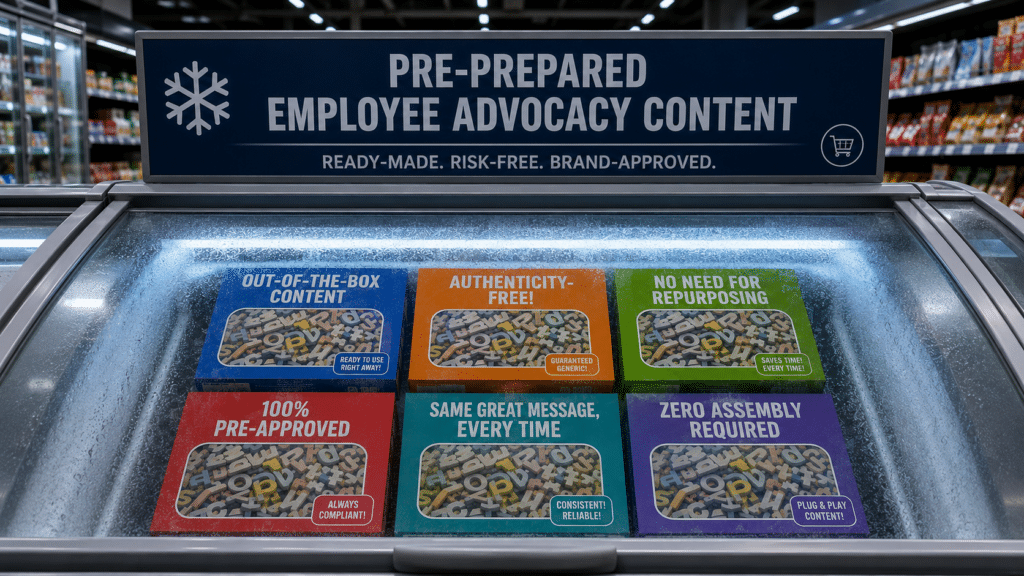
Ask most marketers what an employee advocacy programme involves and they’ll describe a content operation: draft the posts, brief the team, watch the shares roll in. Oyebade doesn’t disagree that ready-made content has its place — for the broadest tier of a programme, “you want to be able to have content that’s ready-made and easy for people to share.” But she’s clear that supplying content is the easy part of the job, not the whole of it.
The harder, more important part is making sure what gets shared still sounds like the person sharing it. “Giving them that confidence to create content that is personal,” she said — not personal in the sense of oversharing, but carrying “that human element” that distinguishes a real voice from “purely AI-generated content.” For anyone she’s coaching to build their own presence, rather than simply amplify a company line, she’s explicit about staying out of the way: “I will not get hands-on with that, because then it needs to sound like it’s coming from them.”
That distinction — between supplying content and enabling a voice — is really a distinction about trust. An audience extends trust to a person, not to a distribution mechanism. Hand someone a script and the trust doesn’t transfer with it; give them a framework and room to sound like themselves, and it does.
Three tiers, three different jobs
One of the more useful things Oyebade offered was a structure most advocacy conversations skip. She doesn’t run one programme; she runs three, each asking something different of the people in it.
At the widest tier is mass amplification — the invitation goes out to the whole company, the content is largely ready-made, and the ask is deliberately light. It’s also where most programmes concentrate their effort, and where success still tends to be measured in reach: impressions, mostly, though Oyebade is increasingly looking past raw numbers to who is actually being reached — the seniority and industry of the audience, not just its size.
Beneath that sits a newer, still-developing layer: individuals who create their own original content in an area they’re genuinely expert in, “content creators that each will have a speciality that is linked to your company.” This is the tier she expects to grow fastest, precisely because it’s where a company’s expertise becomes visible through real people rather than a logo. And separately again, there’s engaging execs, where the content still needs to sound personal, but “there’s a lot more scrutiny when it comes to exec messaging,” because comms, investors and stakeholders are all watching what leadership says in public. Execs, she notes, are usually being positioned as thought leaders as much as amplifiers — the objective shifts from reach to ownership of a topic.
Treating these as one undifferentiated “advocacy programme” is, in her account, where a lot of effort gets wasted. Each tier needs a different level of hand-holding, a different definition of success, and a different tolerance for risk — and conflating them tends to under-serve all three.
The ask nobody quite names
The part of the conversation that stayed with me longest wasn’t about tactics at all. It was Oyebade’s description of what she’s actually asking of people when she invites them into a programme: “You’re asking to borrow their personal real estate. I think that’s quite a big ask.” Employees’ profiles, their networks, their reputations — a company benefits when they’re shared, but none of it belongs to the company.
That’s why, in her account, consent isn’t a compliance checkbox sitting alongside the programme; it’s structural to it. The invitation goes to everyone, but participation has to stay genuinely optional, backed by real training on what the company’s guidelines actually mean in practice. Skip that, and you’re not running an advocacy programme — you’re extracting free distribution from people who never really agreed to the trade.
What actually makes it work
Oyebade is unusually blunt about the limits of her own persuasiveness. “No matter how persuasive you are — I like to think I’m pretty persuasive — you cannot do it on your own,” she told me, before admitting she’d tried it without senior buy-in, and failed. Employee advocacy, in her experience, lives or dies on whether managers and executives visibly do the thing themselves. “When the execs are leading by example, my goodness, it makes your life so much easier.”
It’s a reminder that for all the talk of platforms, algorithms and content formats, advocacy is ultimately an organisational trust problem before it’s a marketing one. You’re asking employees to trust that the company means what it says about wanting their voice — and that trust, too, is built or broken by what leadership actually does, not what the invitation email says.
Looking ahead, Oyebade expects the pressure on this to intensify rather than ease. As AI-generated content becomes cheaper and more ubiquitous, she thinks audiences will increasingly seek out what she calls “homemade” content — the kind that “feels like it’s coming from the heart.” If she’s right, the organisations that have already done the harder work of earning real employee voices, rather than just harvesting shares, will have a genuine advantage that’s difficult for competitors to fake.
Practical takeaways
If you’re building or running an employee advocacy programme, a few things from this conversation are worth taking directly into your planning:
1. Secure buy-in before you build anything else
No amount of internal persuasion substitutes for visible participation from managers and executives. If leadership won’t do it publicly, don’t expect the wider team to.
2. Treat it as three programmes, not one
Mass amplification, specialist content creators and exec engagement each need different levels of support, different guardrails and different definitions of success — don’t run them off the same playbook.
3. Give people frameworks, not scripts
Ready-made content works for broad, opt-in sharing; but wherever you want someone’s own voice to carry weight, resist the urge to write it for them.
4. Make participation genuinely optional.
You’re asking to borrow someone’s personal reputation and network. Treat that as the significant ask it is, with real consent and real training attached — not a mandate dressed up as an opportunity.
5. Build your business case in metrics your company already cares about.
Track where you are now, and be ready to show how the programme moves those specific numbers, rather than inventing new ones nobody else is watching.
6. Match the metric to the tier
Broad, mass-amplification activity is reasonably judged on reach; narrower, targeted campaigns deserve a harder look at who you actually reached, not just how many. Don’t let one measure of success stand in for all three tiers of the programme.
Listen the full podcast episode on employee advocacy here.
Let's connect
Whether you’re looking for a speaker, collaborator, or advisor, I’d love to help you bring fresh perspective to your B2B audience.
Follow me on:


